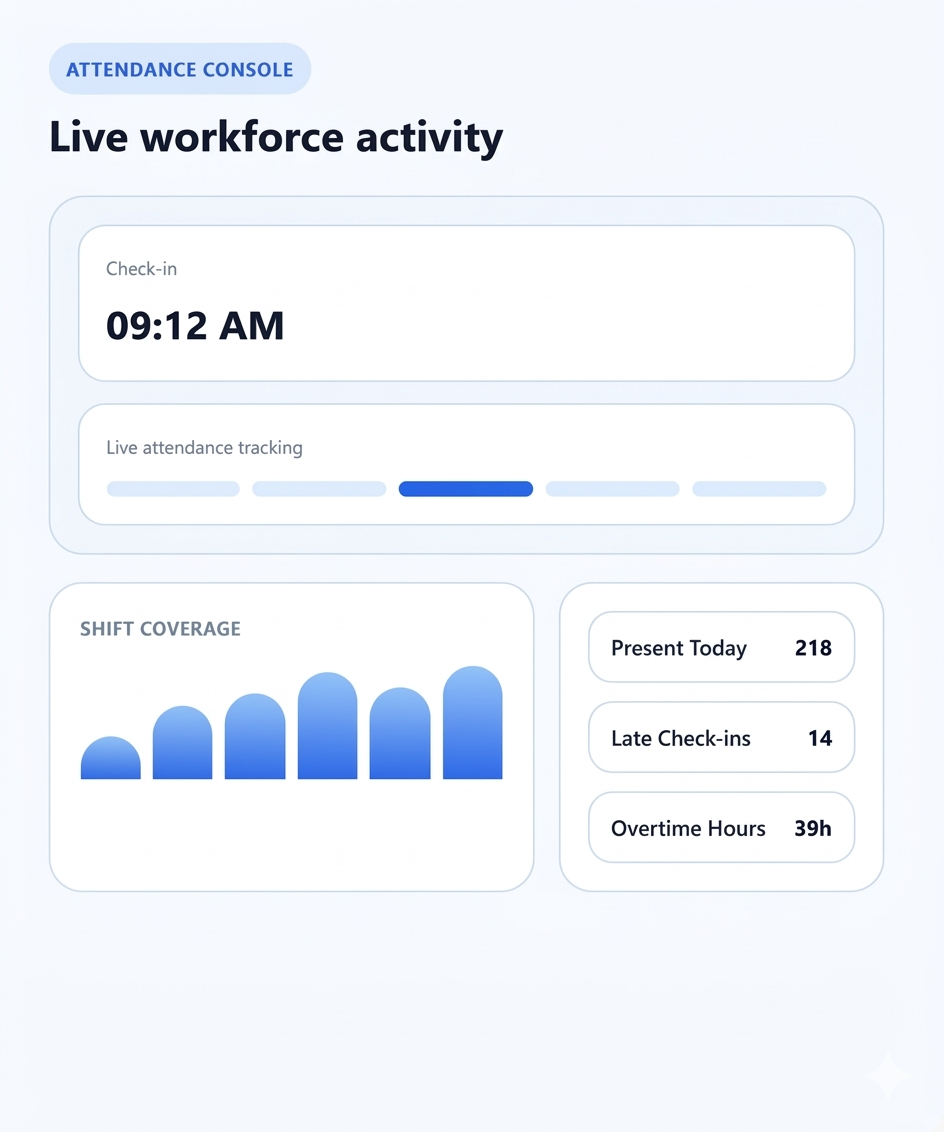
Guide Overview
What Is Attendance Tracking?
Attendance tracking is the process of recording when employees start work, end work, take weekly offs, stay absent, arrive late, work overtime, or follow shift schedules. It creates the base data needed for payroll, workforce planning, and performance visibility.
In modern businesses, attendance management is more than punch-in and punch-out. It also includes location control, shift mapping, holiday handling, approval workflows, attendance correction, and exception review before payroll is processed.
What Are the Main Attendance Tracking Methods?
Businesses typically use different attendance methods depending on workforce type, work location, and operational discipline.
Method 1
Biometric
Best for factories, plants, warehouses, and fixed-site office operations that need reliable identity-based check-in.
Method 2
Mobile + Geofencing
Useful for field teams, distributed sales teams, and hybrid employees who need location-aware attendance control.
Method 3
Web or Self-Service
Suitable for office and hybrid teams where login-based or manager-approved attendance capture is acceptable.
Factory Attendance Tracking
Factory attendance environments need tighter control because shift discipline, gate-level attendance, overtime, and contractor presence all affect payroll and workforce output directly.
Biometric Integration
Factories usually depend on biometric devices for accurate attendance capture. The system should sync device logs cleanly, handle multiple gates or lines, and reduce duplicate or missed punch issues.
Shift-Based Validation
Attendance should be tied to shift allocation, weekly off rules, holiday treatment, and overtime logic so that each worker’s attendance is evaluated against the correct schedule.
Office and Hybrid Attendance Tracking
Office and hybrid teams often need more flexibility than factory teams, but that flexibility still needs control. Hybrid attendance should reflect work mode, reporting expectations, late marks, and manager approvals without creating ambiguity.
Location-Aware Marking
Geofencing and mobile attendance can help verify presence for remote or field-linked employees. For office-based teams, web or ESS attendance may be enough when backed by clear policy and approval workflows.
Manager Visibility
Managers should have visibility into late arrivals, exceptions, missed check-ins, and team availability so HR is not the only function monitoring attendance patterns.
Shift, Late Mark, and Overtime Rules
Attendance accuracy depends heavily on whether shift rules are configured properly. Good attendance operations define what counts as on-time, late, half-day, overtime-eligible, or absent under each schedule.
- Shift start and end time rules
- Grace periods and late mark thresholds
- Half-day and short-hour treatment
- Weekly off and holiday attendance logic
- Overtime thresholds and approval routing
Without these controls, payroll teams spend too much time correcting attendance-derived salary issues manually.
Attendance Exception Handling
Every business faces attendance exceptions such as missed punches, forgotten check-outs, shift swaps, emergency leave changes, and approval delays. A good attendance process should make these exceptions visible and manageable before payroll starts.
Correction Workflow
Employees should be able to raise attendance correction requests, managers should review them quickly, and HR should not need to manually reconcile every mismatch by default.
Payroll Impact Review
Attendance exceptions that remain unresolved can affect loss of pay, overtime payouts, and payable days. That is why unresolved exceptions should be reviewed before payroll lock.
Common Attendance Challenges
Attendance becomes difficult to manage when businesses combine multiple locations, shift-based work, field movement, and manual approvals. Common challenges include:
- Missed punches and inconsistent biometric data
- Weak control over field or remote attendance marking
- Late approvals for exceptions and overtime
- Manual attendance corrections before payroll
- Poor visibility into absenteeism and workforce availability
These issues become more serious when attendance data directly drives payroll and production planning.
What Good attendance software Should Automate
Attendance software should help teams move from reactive correction to structured control. It should not only capture check-ins, but also improve validation, visibility, and approval discipline.
Capture Methods
Support biometric devices, mobile attendance, geofencing, ESS marking, and flexible capture for different workforce types.
Rule Engine
Configure shift schedules, grace periods, half-days, overtime logic, and holiday or weekly off treatment accurately.
Exception Workflow
Allow employees and managers to resolve attendance mismatches quickly before the payroll cycle begins.
Payroll Integration
Sync payable days, loss of pay, overtime, and attendance-based inputs directly into payroll with less manual dependency.
A good attendance platform helps businesses improve workforce visibility while reducing payroll risk and manual attendance disputes.
Conclusion
Attendance tracking is a control system, not just an HR record. When attendance methods, shift rules, approvals, and exception handling are structured properly, businesses gain cleaner payroll inputs, better workforce visibility, and fewer disputes. For factories, offices, and hybrid teams alike, better attendance control supports both operational discipline and payroll accuracy.