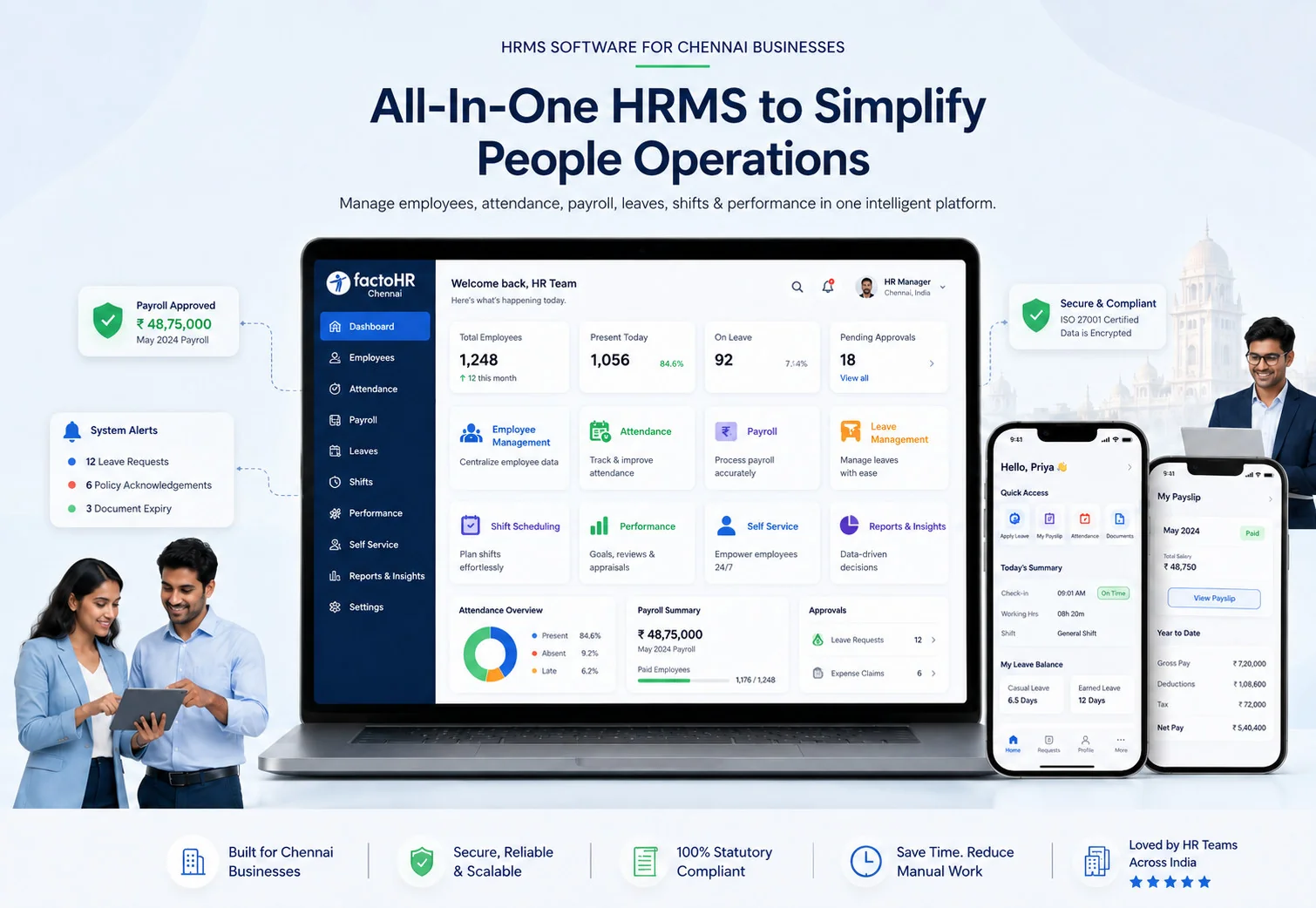
What is HR and payroll software for IT companies in Chennai?
HR and payroll software for IT companies in Chennai is a workforce management platform that handles ESOP TDS computation under Section 17(2), variable pay with three-point salary checks, contractor payroll under Section 194J, flexible benefit plans, OKR-linked appraisals, hybrid attendance across office and WFH, and full statutory compliance - all in a single system built for Chennai's IT corridors.
How is ESOP TDS calculated in payroll software for IT companies?
ESOP is taxed as a perquisite under Section 17(2) at the time of exercise. The perquisite value equals the Fair Market Value on the exercise date minus the exercise price. Payroll software for IT companies stores grant date, vesting schedule, exercise price, and FMV per employee, computes the perquisite automatically, adds it to the salary for the exercise month, deducts the correct TDS, and updates Form 16 Part B - without requiring manual entry by HR or Finance.
What is a Flexible Benefit Plan and how does HRMS software handle it for IT employees?
A Flexible Benefit Plan allows IT employees to allocate their CTC across tax-advantaged components - HRA, LTA, food coupons, fuel reimbursement, and children's education allowance - within a defined band. HRMS software for IT companies opens a declaration window at the start of the financial year, validates CTC band limits, recalculates the salary structure, and ensures the correct components flow into monthly payroll so employees save tax without HR manually editing salary structures for each employee.
How does contractor payroll under Section 194J work in IT company payroll software?
IT companies engage consultants, freelance developers, and technical professionals under Section 194J (fees for professional or technical services), which requires TDS deduction at 10% - entirely separate from the EPFO, ESIC, and PT obligations of regular employees. Payroll software for IT companies maintains a parallel payment ledger for contractors, deducts TDS at 10% automatically, generates Form 16A at year-end, and exports TRACES-ready challan data without mixing contractor payments into the employee salary register.
Can HRMS software detect moonlighting in IT companies?
HRMS software can surface moonlighting indicators by cross-referencing employee EPF UAN records against declared employer data and flagging cases where UAN shows contributions from multiple employers. Attendance pattern analysis can also highlight irregular check-in behaviour - such as consistent late arrivals or missing check-ins - that may warrant HR review. This helps Chennai IT companies manage dual-employment policy compliance without invasive monitoring tools.
How does OKR-linked appraisal work in HR software for IT companies?
OKR-linked appraisal connects objective completion scores, manager ratings, and peer feedback into a weighted final score. HR software for IT companies uses this score to calculate the increment percentage against the employee's compensation band, auto-generates salary revision letters, and routes them through the HR approval workflow - closing the entire appraisal cycle within 48 hours of manager sign-off, without manual increment sheets or offline spreadsheets.
Why do IT companies in OMR and Sholinganallur choose this HR software over national HRMS platforms?
National HRMS platforms are built for generic payroll. IT companies in OMR, Sholinganallur, and Tidel Park need ESOP TDS automation, FBP self-service, 194J contractor separation, OKR appraisals, and hybrid attendance - all maintained with Tamil Nadu professional tax slabs, Chennai municipal compliance, and local support. This HRMS is actively deployed in Chennai's IT corridor with these features built in, not bolted on as add-ons.
What statutory compliance does HR software handle for IT companies in Tamil Nadu?
HR software for IT companies in Tamil Nadu handles EPFO ECR filing, ESIC challan generation, Tamil Nadu professional tax (PT slab-based deduction and challan), TDS on salary via Form 24Q, TDS on contractor fees via Form 26Q under Section 194J, and POSH annual report tracking. Compliance calendar reminders trigger 10 days before each deadline and the relevant statutory files are auto-generated in the required format for each authority.