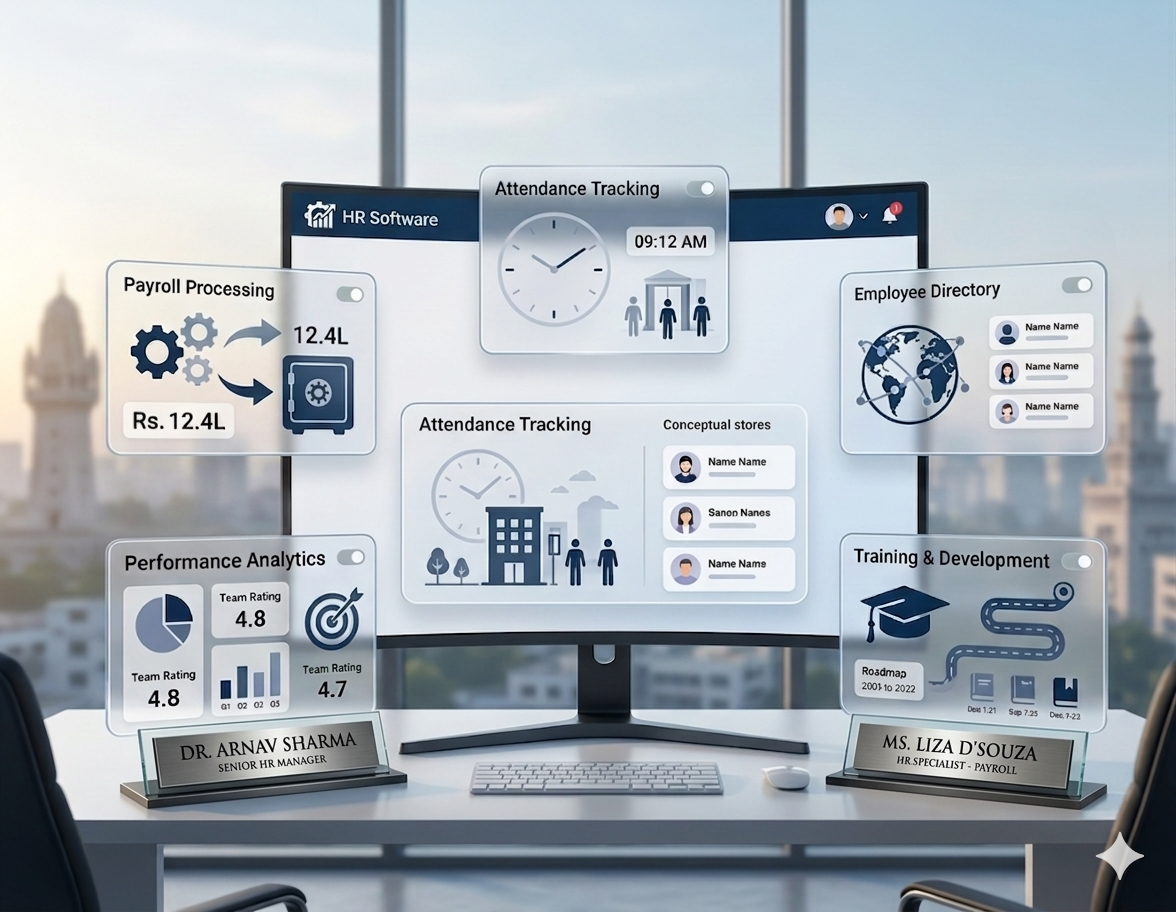
A cloud-based HRMS is HR software hosted on the internet that allows businesses to manage their entire HR lifecycle — hiring, onboarding, attendance, payroll, compliance, and more — through a single online platform, accessible from any device.
Why Businesses Are Moving to Cloud-Based HRMS
Manual processes and disconnected tools create data silos, compliance risk, and HR inefficiency. Remote and hybrid workforces have made on-premise HR systems obsolete. Cloud HRMS delivers scalability without proportional cost, automates repetitive HR work, enables real-time data visibility, and handles Indian payroll compliance (EPF, ESI, TDS, PT) automatically.
How a Cloud-Based HRMS Works
- Cloud login — access via browser or mobile app, role-based permissions
- Centralized employee database — all records, salary, documents in one place
- Module-based operations — payroll, attendance, leave integrated and auto-synced
- Real-time updates — any change reflects instantly across all modules
- Automated workflows — approvals, reminders, payroll processing triggered by rules
- Reporting and analytics — live dashboards for headcount, cost, compliance
Key Modules in a Cloud-Based HRMS
Core HR / Employee Database, Payroll Management (EPF/ESI/TDS/PT automation), Attendance Management (biometric + app + web), Leave Management (approval workflows, LOP deduction), Employee Self-Service (payslips, Form 16, leave apply), Recruitment and Onboarding, Performance Management, Expense Management.
Key Features Checklist
- Cloud accessibility — any device, any location, anytime
- Data security — AES-256 encryption, role-based access, ISO 27001
- Automation workflows — configurable approvals, scheduled payroll
- Real-time reporting — live dashboards across all HR modules
- Mobile app access — Android and iOS for HR teams and employees
- Integration capabilities — biometric, accounting software, third-party tools
- Scalability — handles growth without re-implementation
- Role-based access — HR, manager, employee, admin views configured separately
Benefits of Cloud-Based HRMS
For employees: self-service access to payslips and leave, real-time transparency, better onboarding experience. For HR and business: centralized data, payroll processing reduced from days to hours, automated compliance (EPF/ESI/TDS/PT), scalability, and real-time decision-making data.
Cloud-Based HRMS vs On-Premise HRMS
Cloud HRMS has low setup cost (subscription, no hardware), anywhere accessibility, automatic updates, 2–4 week implementation, and native remote access — compared to on-premise which requires servers, IT teams, VPN, and 3–6 month implementation. Cloud also provides automatic disaster recovery vs local backup dependency.
Who Should Use a Cloud-Based HRMS?
- SMEs (20–500 employees) managing HR beyond Excel capacity
- Startups scaling rapidly (10 to 150 employees in 12–18 months)
- Multi-location organizations needing centralized HR with location-specific payroll
- Remote and hybrid workforces with no office server to connect to
- Compliance-heavy businesses in manufacturing, healthcare, IT, hospitality
Common Problems Without Cloud HRMS
- Data silos — attendance, leave, payroll in separate disconnected systems
- Manual errors — salary miscalculations, wrong LOP deductions
- Lack of visibility — no real-time headcount, cost, or compliance data
- Compliance risk — missed EPF, ESI, TDS deadlines leading to penalties
- HR inefficiency — 40–60% of HR time on administrative tasks
- Poor employee experience — slow approvals, unavailable payslips
How to Choose the Right Cloud HRMS
- Ease of use — clean UX, minimal training required for adoption
- Modules included — confirm each is genuinely functional, not just listed
- Integration capabilities — biometric, Tally, Zoho Books, other tools
- India compliance depth — PT by state, Form 24Q, ECR format PF challan
- Security standards — AES-256, 2FA, audit logs, ISO 27001
- Scalability — handles 10x headcount without re-implementation
- Support quality — reachable during payroll cycles, not just business hours
How Cloud HRMS Connects All HR Functions
Attendance feeds payroll (present days, LOP, overtime auto-synced). Leave syncs with payroll (approved balances update before cycle). Employee database drives compliance (PAN, UAN, salary data ensures accurate TDS and EPF without re-entry). ESS reduces HR workload by 30–40% for routine requests. Reporting spans all modules for complete, accurate CTC and attrition insights.
Implementation Guide
- Assess current HR processes — document pain points and gaps
- Define requirements — modules, integrations, compliance needs, team size
- Shortlist and select software — demo with your actual scenarios
- Data migration — export, clean, and validate existing employee data
- System configuration — salary structures, leave policies, statutory rules, workflows
- Training — HR admins on payroll/compliance, managers on approvals, employees on ESS
- Parallel run and go live — verify one payroll cycle before decommissioning old process
Real Business Use Cases
A logistics company with 60 employees reduced payroll processing from 4 days to 5 hours after cloud HRMS connected their biometric device to payroll. A Pune SaaS startup reduced onboarding from 2 weeks to 2 days and handled payroll for 90 employees with a 2-person HR team after moving from outsourced payroll and Google Sheets. A 5-outlet Gujarat retailer gained centralized HR data, correct city-wise PT, and real-time reporting across all locations in one system.
Frequently Asked Questions
What is a cloud-based HRMS?
A cloud-based HRMS is HR software hosted online that manages employee records, payroll, attendance, leave, and compliance through a single internet-accessible platform — with no hardware installation required.
How is cloud HRMS different from traditional HR software?
Traditional HR software is installed on a local server, accessible only from the office, and requires IT maintenance. Cloud HRMS runs on remote servers, is accessible from any device, updates automatically, and scales without hardware investment.
Is cloud HRMS secure for employee data?
Yes. Reputable cloud HRMS platforms use AES-256 encryption, role-based access control, two-factor authentication, regular security audits, and ISO 27001-certified infrastructure. Data is often more secure than on local servers.
Can a cloud HRMS handle Indian payroll compliance?
Yes. A cloud HRMS built for India automates EPF (12% of basic), ESI (0.75% employee contribution), TDS (monthly computation), and state-wise Professional Tax — along with generating compliance reports, challans, and Form 24Q for filing.
Is cloud HRMS suitable for small businesses?
Absolutely. Cloud HRMS delivers enterprise-grade HR capability at a subscription cost, requires no IT team, and can be implemented in 2–4 weeks. It scales as you grow — you do not outgrow it.
What modules are typically included in a cloud HRMS?
A full-featured cloud HRMS includes: Core HR (employee database), Payroll, Attendance, Leave, Employee Self-Service, Recruitment and Onboarding, Performance Management, and Expense Management.
How long does it take to implement cloud HRMS?
For most SMEs, implementation takes 2–4 weeks, including data migration, configuration, and training. Cloud-based systems are significantly faster to deploy than on-premise solutions, which can take 3–6 months.
Can cloud HRMS support multiple office locations?
Yes. Cloud HRMS handles multi-location payroll with location-specific PT rules, separate attendance setups, and consolidated reporting — all within a single platform accessible from every office.