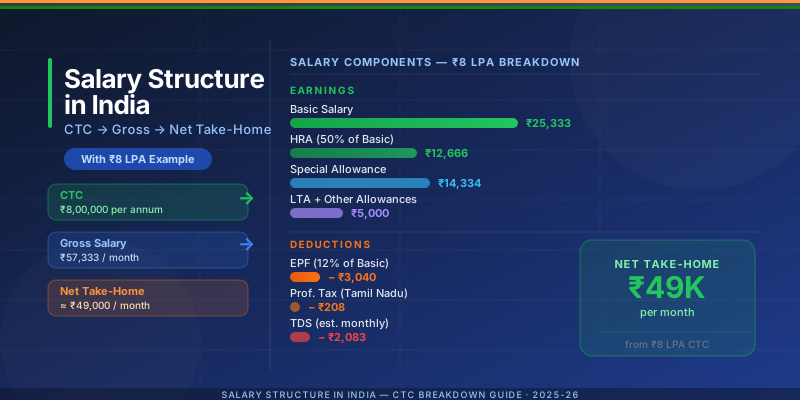
You get an offer letter. It says your CTC is ₹8 LPA. You feel great. Then your first salary hits your bank account, and it is nowhere near ₹66,667.
That gap is confusing, and you are not alone in feeling it. Most salaried employees in India have never had someone clearly explain what their salary is actually made of. This guide breaks down every component of your salary, with a real example at the end.
In this guide:
What a salary structure is, the key terms every employee must know (CTC, Gross Salary, Net Salary), each earnings and deduction component explained, a worked example with a ₹8 LPA CTC, and practical tips to increase your take-home pay. Many professionals also use an automated salary calculation tool to quickly estimate their monthly take-home before accepting an offer.
What Is a Salary Structure?
A salary structure is the breakdown of your total pay package into individual components. It shows how your compensation is split between earnings (what you receive) and deductions (what is taken out before the money reaches you).
Your employer designs this structure to balance two things: your take-home pay and the company’s cost of employing you. These two numbers are almost never the same, and understanding the difference is where most salary confusion begins.
Today, most companies use cloud-based payroll software to structure salaries automatically, ensuring compliance, tax accuracy, and transparent salary breakdowns for employees.
Key Salary Terms You Must Know
Before examining the individual components, it is important to understand three key terms that appear frequently.
CTC (Cost to Company)
CTC is the total amount your employer spends on you in a year. It includes your monthly salary, employer contributions to the provident fund, gratuity, insurance premiums, and any other benefits the company provides. The formula is:
CTC = Gross Salary + Employer PF Contribution + Gratuity + Other Benefits
CTC is not what you take home. It is the total amount the company pays to employ you. Most organizations now use the cloud-based payroll software to define and present CTC structures clearly to employees during hiring.
Gross Salary
Gross salary is your total earnings before tax and other deductions. It includes your basic salary plus all allowances.
Gross Salary = Basic Salary + HRA + All Other Allowances
Net Salary / Take-Home Salary
Net salary is what actually lands in your bank account every month after all deductions.
Net Salary = Gross Salary − Income Tax (TDS) − Employee PF − Professional Tax
Salary Components in India: Earnings Side
Every Indian salary has two sides: earnings and deductions. Here is what makes up the earnings side.
Basic Salary
Basic salary is the core of your entire compensation. Typically, basic salary is 40–50% of your CTC in private sector jobs. A higher basic sounds good, but it also means higher PF deductions and higher taxable income.
House Rent Allowance (HRA)
HRA is an allowance your employer pays to help cover your rental costs. In most private companies, HRA is set at 40–50% of basic salary — 50% in metro cities like Mumbai, Delhi, Bengaluru, or Kolkata, and 40% in other cities. HRA can be partially or fully tax-exempt if you live in rented accommodation.
Leave Travel Allowance (LTA)
LTA covers domestic travel costs when you take a holiday within India. Your employer declares an LTA component in your CTC, and you can claim it as tax-exempt when you actually travel. Key conditions:
- You need to submit travel tickets as proof
- Only the fare (flight, train, bus) is covered — not hotel or food
- You can claim it for two trips in a block of four calendar years
Special Allowance
Special allowance is the flexible “leftover” component in most private-sector salary structures. After Basic, HRA, LTA, and other defined allowances are calculated, whatever remains in the salary budget is often labelled as special allowance. It is fully taxable.
Dearness Allowance (DA)
DA is a living cost adjustment paid to help employees cope with inflation. In India, it applies mainly to central government employees, state government employees, and public sector units (PSUs). It is rare in private sector salary structures.
Other Common Allowances
Depending on your employer and role, you may also see:
- Conveyance allowance: For commuting costs
- Medical allowance: A fixed amount for medical expenses
- Performance bonus: Variable pay tied to your or the company’s performance
- Reimbursements: Mobile bills, fuel, internet, or books — usually more tax-friendly than cash allowances
Salary Components in India: Deductions Side
These are the components that reduce what you take home each month.
Employee Provident Fund (EPF)
EPF is a mandatory retirement savings scheme. Every month, 12% of your basic salary is deducted from your pay and deposited into your EPF account. Your employer also contributes 12% of your basic — but this amount comes out of your CTC, not in addition to it.
The employer’s 12% is split further: approximately 8.33% goes into the Employees’ Pension Scheme (EPS) and 3.67% into your actual EPF account. The maturity amount is tax-free if withdrawn after 5 years of continuous service.
Professional Tax
Professional tax is a state-level tax charged on salaried employees. The maximum is ₹2,500 per year, and the actual amount varies by state. States like Delhi, Haryana, Rajasthan, Uttar Pradesh, and Punjab do not levy professional tax. States like Karnataka, Maharashtra, West Bengal, and Tamil Nadu do.
Income Tax (TDS)
Your employer deducts income tax at source (TDS) from your salary every month based on your projected annual income and your declared investments. At the start of each financial year, you declare your tax-saving investments (like PPF, ELSS, insurance premiums under Section 80C) and other deductions (HRA, LTA). Your employer uses this to estimate your tax liability and spread the deduction across 12 months.
Salary Structure Example — Real Calculation (CTC ₹8 LPA)
Let’s put this all together with a real example. Meet Priya, a software engineer in Bengaluru with a CTC of ₹8,00,000 per year.
Step 1: Annual Salary Breakup
| Component | Annual Amount |
|---|---|
| Basic Salary (40% of CTC) | ₹3,20,000 |
| HRA (50% of Basic, metro city) | ₹1,60,000 |
| Special Allowance | ₹1,72,800 |
| LTA | ₹20,000 |
| Employer PF Contribution (12% of Basic) | ₹38,400 |
| Gratuity (4.81% of Basic) | ₹15,392 |
| Medical Insurance (Company-paid) | ₹12,000 |
| Total CTC | ₹7,38,592* |
*Note: CTC structures vary. Some companies include insurance and gratuity in CTC; others show them separately. The above reflects a common structure.
Step 2: Monthly Gross Salary
| Component | Monthly Amount |
|---|---|
| Basic Salary | ₹26,667 |
| HRA | ₹13,333 |
| Special Allowance | ₹14,400 |
| LTA | ₹1,667 |
| Gross Salary | ₹56,067 |
Step 3: Monthly Deductions
| Deduction | Monthly Amount |
|---|---|
| Employee PF (12% of Basic) | ₹3,200 |
| Professional Tax (Karnataka) | ₹200 |
| Income Tax / TDS (estimated, new regime) | ₹3,500 |
| Total Deductions | ₹6,900 |
Step 4: Take-Home Salary
Net Salary = ₹56,067 − ₹6,900 = ₹49,167 per month
So while Priya’s CTC is ₹8 LPA, she takes home around ₹49,000 per month — not ₹66,667. The difference accounts for employer-side costs (PF, gratuity, insurance) and monthly deductions.
Tips to Maximize Your Take-Home Salary
You cannot always control your CTC, but you can make smart choices to keep more of what you earn.
- Pick the right tax regime: Compare your tax liability under the old and new regime. The new regime’s lower rates often work better if you have fewer deductions.
- Claim HRA exemption properly: Submit rent receipts to your employer. For rent above ₹1 lakh per year, you also need your landlord’s PAN.
- Use LTA wisely: You can claim LTA twice in a 4-year block. Plan a domestic trip and keep your travel tickets — it can save you meaningfully in taxation annually.
- Opt for reimbursements over taxable allowances: Prefer reimbursements (meal coupons, fuel, internet, books) over equivalent cash allowances where your employer offers the choice.
- Think carefully before increasing VPF: Voluntary PF contributions are a strong long-term savings tool, but they reduce take-home salary. Only increase VPF if you can afford the reduction.
Understanding Your Salary Is the First Step
Most salary confusion comes from not knowing the difference between CTC, gross salary, and take-home pay. Once you understand the structure, the numbers stop being surprising — and you can start making informed decisions about tax declarations, investment choices, and negotiations.
If you are an HR team or payroll manager in India, a clear salary structure also reduces employee queries, payslip disputes, and onboarding confusion. HR and Payroll software that auto-generates payslips with component-level breakdowns eliminates most of these conversations before they start.
Takeaway:
CTC is what the company spends. Gross is what you earn before deductions. Net is what you actually receive. Every salary question becomes answerable once you know which number you are looking at.
Related Terms
Gross Salary
Net Salary
HRA (House Rent Allowance)
EPF (Employee Provident Fund)
TDS (Tax Deducted at Source)
Professional Tax
LTA (Leave Travel Allowance)