Running payroll in Tamil Nadu is not just about calculating salaries and paying employees. You are also managing a web of central laws and state-specific rules, and both need your attention every single month.
Miss a Professional Tax deposit deadline. File the wrong form under the Tamil Nadu Shops Act. Skip the Labour Welfare Fund contribution in June. Any one of these can result in penalties, an inspection, or a compliance audit you were not prepared for. This checklist covers everything your HR team needs to stay on track, from first-time registrations to annual filings, with Tamil Nadu-specific details.
Why Payroll Compliance Is a Bigger Risk for Tamil Nadu SMEs
Tamil Nadu has one of the most active labour enforcement environments in South India. The state runs its own inspectorate across districts, and ESIC maintains large regional offices in Chennai and Coimbatore that conduct periodic audits.
As an SME, you face a dual compliance burden. You must follow central laws like the EPF Act, ESI Act, and Income Tax Act — while also meeting state-specific requirements under the Tamil Nadu Shops and Establishments Act, the Tamil Nadu Payment of Wages Rules, and the Tamil Nadu Factories Rules.
The risk is real. Penalties for late PF deposits start at 12% per annum in simple interest and include damages for the arrears. Late TDS deposits attract interest of 1.5% per month. And if a labour inspector identifies missing registers or unfiled returns, you may face compounding fines across multiple acts at once.
Step 1: Get Your Business Registrations Right
Before you run your first payroll, make sure these registrations are in place.
Shops and Establishments Act
Every commercial establishment in Tamil Nadu must register under the Tamil Nadu Shops and Commercial Establishments Act. You apply to the local Inspector of Shops and Establishments in the district where your business operates.
Professional Tax Registration
Tamil Nadu levies Professional Tax, and it is administered by the Commercial Tax Department. You need two separate registrations:
- PTEC (Professional Tax Enrolment Certificate): For the employer or business entity itself
- PTRC (Professional Tax Registration Certificate): To deduct and remit PT from employee salaries
Apply online through the Tamil Nadu Commercial Taxes portal. Both registrations are mandatory from the first month you pay salaries.
EPFO and ESIC Registration
You must register with the Employees’ Provident Fund Organisation (EPFO) once you have 20 or more employees. ESIC registration is required if you have 10 or more employees and at least some earn ₹21,000 or less per month.
Step 2: Monthly Payroll Deductions Checklist
Every payroll run involves calculating and deducting the right amounts across five separate statutory heads. Here is what to check each month.
TDS on Salaries (Income Tax)
Deduct TDS from each employee’s salary based on their declared tax regime (old or new), their investment proof submissions, and the applicable income tax slab for the financial year.
- Deposit TDS with the government by the 7th of the following month (April deposit deadline is the 30th of April)
- File quarterly TDS returns using Form 24Q
- Issue Form 16 to employees by June 15 each year
Provident Fund (EPF and EPS)
Both the employee and employer contribute 12% of the employee’s basic wages each month.
- Employee: 12% goes entirely into EPF
- Employer: 8.33% goes into EPS (capped at ₹1,250 for employees earning above ₹15,000 basic) and 3.67% into EPF
- Deposit via Electronic Challan cum Return (ECR) by the 15th of each month
Make sure every new eligible employee has a UAN (Universal Account Number) activated before their first payroll.
Employees’ State Insurance (ESI)
ESI applies to employees earning up to ₹21,000 per month (₹25,000 for employees with disabilities).
- Employee contribution: 0.75% of gross wages
- Employer contribution: 3.25% of gross wages
- Deposit contributions by the 21st of each month
Register new employees with ESIC within 10 days of joining. File half-yearly ESI returns and maintain an up-to-date register of covered employees.
Professional Tax: Tamil Nadu Slab Rates
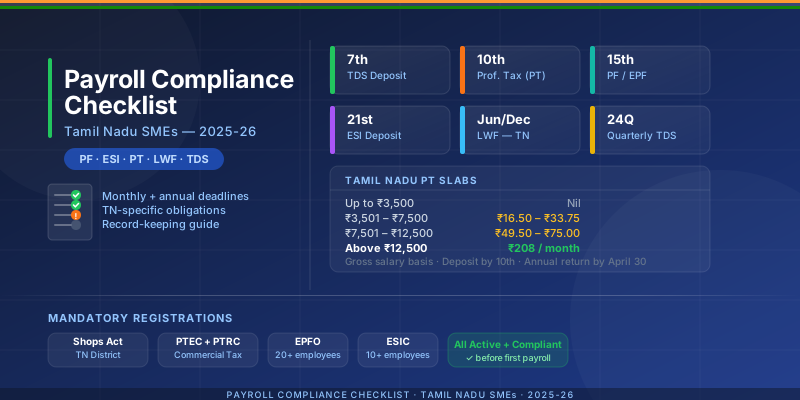
Tamil Nadu Professional Tax is deducted from employee salaries based on the following monthly salary slabs:
| Monthly Salary (₹) | PT Deduction (₹) |
|---|---|
| Up to 3,500 | Nil |
| 3,501 to 5,000 | 16.50 |
| 5,001 to 7,500 | 33.75 |
| 7,501 to 10,000 | 49.50 |
| 10,001 to 12,500 | 75.00 |
| Above 12,500 | 208.00 |
Deposit the deducted amount with the Tamil Nadu Commercial Taxes Department by the 10th of the following month for monthly filers. File annual PT returns by the 30th of April each year.
Labour Welfare Fund (Tamil Nadu)
Tamil Nadu mandates LWF contributions twice a year, in June and December.
- Employee contribution: ₹10 per period
- Employer contribution: ₹20 per period
The contributions are small, but the filing obligation is real. Many SMEs miss the December deadline because it falls close to the year-end payroll cycle.
Step 3: Statutory Filing Deadlines for Tamil Nadu
Use this as your reference calendar.
Monthly Deadlines
| Due Date | Compliance |
|---|---|
| 7th | TDS deposit for the previous month |
| 10th | Professional Tax deposit (Tamil Nadu) |
| 15th | PF/EPF contribution deposit via ECR |
| 21st | ESI contribution deposit |
| End of month | Issue salary slips to all employees |
Quarterly Deadlines
| Period | Compliance | Due Date |
|---|---|---|
| Apr to Jun | TDS return Form 24Q (Q1) | July 31 |
| Jul to Sep | TDS return Form 24Q (Q2) | October 31 |
| Oct to Dec | TDS return Form 24Q (Q3) | January 31 |
| Jan to Mar | TDS return Form 24Q (Q4) | May 31 |
| Apr to Jun | Employment Exchange ER-I return | July 15 |
| Jul to Sep | Employment Exchange ER-I return | October 15 |
Half-Yearly Deadlines (Tamil Nadu Specific)
| Period | Compliance | Due Date |
|---|---|---|
| Jan to Jun | Tamil Nadu Factories Act half-yearly return (Form 21) | July 30 |
| Jan to Jun | Contract Labour half-yearly return (Form XXIV) | July 29 |
| Jan to Jun | Inter-State Migrant Workmen’s half-yearly return | Within 30 days of June 30 |
| Apr to Sep | ESI half-yearly return | November 11 |
| Oct to Mar | ESI half-yearly return | May 12 |
Annual Deadlines
| Compliance | Due Date |
|---|---|
| Form 16 to employees | June 15 |
| PF annual return | April 30 |
| Professional Tax annual return (Tamil Nadu) | April 30 |
| LWF annual statement | January 31 |
| Payment of Bonus | Within 8 months of financial year close (by November 30) |
| Gratuity fund actuarial review | Before March 31 |
| IT/ITeS self-certification forms | July 30 |
Step 4: Tamil Nadu-Specific Laws SMEs Frequently Overlook
Tamil Nadu has its own obligations that are separate from central law.
Tamil Nadu Shops and Establishments Self-Certification (IT/ITeS)
If your business falls under the IT or ITeS category, you must file self-certification forms with the local Inspector by July 30 each year under the following acts:
- Tamil Nadu Shops and Commercial Establishments Act (Form O)
- Tamil Nadu Payment of Gratuity Rules (Form V)
- Minimum Wages (Tamil Nadu) Rules (Form XII)
- Tamil Nadu Payment of Wages Rules (Form VIII)
Tamil Nadu Minimum Wages: Scheduled Employment Categories
Tamil Nadu notifies its own minimum wages for scheduled employments. These are different from the central government’s floor wage. If your business falls under a scheduled employment category — such as manufacturing, construction, retail trade, or security services — you must pay at least the Tamil Nadu-notified rate for that category. The state revises these rates periodically at the start of each financial year and after the monsoon revision (usually October).
Contract Labour Act Compliance (For SMEs Using Third-Party Staff)
If you use contractors or third-party labour agencies to supply workers to your premises, the Contract Labour (Regulation and Abolition) Act applies to you as a principal employer.
- You need a Registration Certificate from the labour department
- Your contractor needs a License
- Contractors must file a half-yearly return (Form XXIV) by July 29 for the January to June period
Inter-State Migrant Workmen Act
If your business in Tamil Nadu employs workers recruited from other states, you must register under the Inter-State Migrant Workmen (Regulation of Employment and Conditions of Service) Act. Half-yearly returns are due within 30 days of the close of each half-year. The annual return is due by February 15.
Step 5: Payroll Records You Must Keep (and for How Long)
Good record-keeping is not just good practice — it is a legal requirement under most of the acts that govern your payroll.
Records to Maintain
- Salary register and payslips for every employee
- Attendance and leave registers
- PF and ESI challans and ECR filings
- TDS deduction records and Form 16 copies
- Professional Tax payment receipts
- LWF contribution receipts (June and December)
- Bonus calculation sheets and payment proof
- Gratuity records for employees who have completed five or more years
Retention Periods
| Record Type | Retention Period |
|---|---|
| PF and ESI records | 5 years from date of last entry |
| TDS records | 7 years from end of relevant financial year |
| Payroll registers (general) | Minimum 3 years (5 years recommended) |
| Bonus and gratuity records | 3 years after last payment |
Store digital copies with proper access controls. A government auditor or labour inspector can request records from the past three to five years with very little notice.
Common Payroll Compliance Mistakes Tamil Nadu SMEs Make
Even experienced HR teams should watch out for these:
- Wrong Professional Tax slab applied: PT slabs are based on monthly gross salary, not basic pay. Applying PT to basic pay alone leads to systematic under-deduction and accumulated liability.
- Missing the LWF June contribution: The June deadline falls mid-year when HR teams are busy with appraisals and increment cycles. Then December is missed too, and by year-end you have two unfiled periods.
- Not filing IT/ITeS self-certification forms: Many IT companies in Chennai assume their HR software handles everything, but self-certification is a manual filing with the local Inspector.
- Using outdated minimum wage rates: The state revises rates twice a year in some categories. Using the previous revision’s rates for even one month creates a wage arrears liability.
How HR Software Chennai Makes Tamil Nadu Payroll Compliance Easier
Managing Tamil Nadu’s compliance calendar manually is doable for a team of 10. For a team of 50 or 150, it becomes a full-time job in itself.
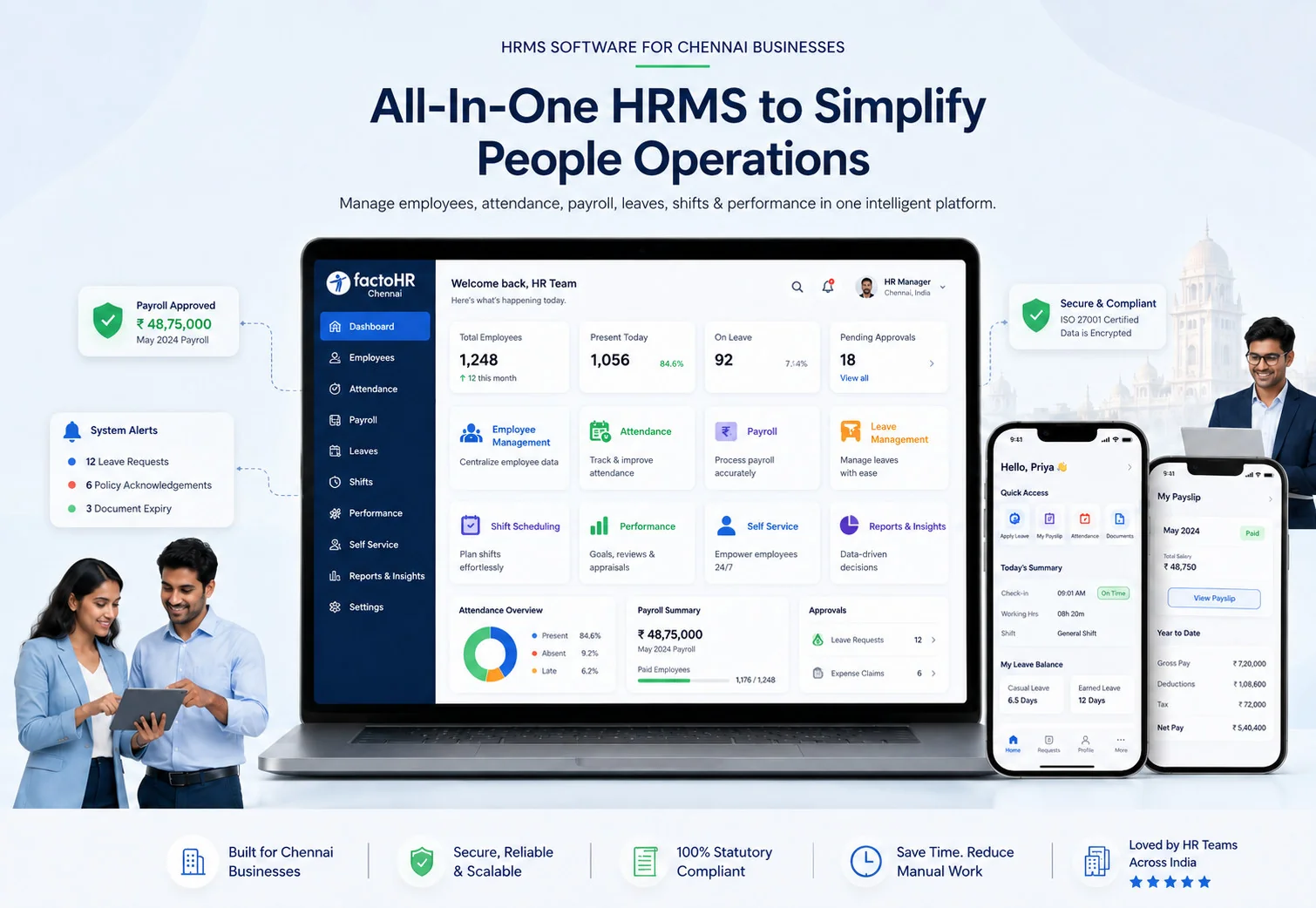
We built payroll software for Indian compliance and will automatically handle your monthly PF, ESI, and TDS calculations, apply the correct Tamil Nadu PT slabs, and flag upcoming filing deadlines before they are due. It also stores all your payroll records in one place for audit purposes.
Its purpose-built system understands Tamil Nadu’s specific requirements — not just the defaults of central law.