
Growth creates paperwork. Not metaphorically, literally. Every new hire generates an offer letter, an appointment letter, a PF nomination form, an ESI declaration, a bank mandate, a tax declaration, an ID proof, an address proof, an educational certificate stack, and a signed copy of the employee handbook. Multiply that by 20 new joiners a month, add the ongoing documentation of appraisals, promotions, transfers, disciplinary actions, and exits, and the employee record burden of a growing business becomes one of its least-managed operational risks.
Most growing businesses in Chennai handle this the same way. A shared Google Drive folder organized by someone who has since left. An HR executive’s laptop with a folder structure that makes sense only to her. A filing cabinet in the HR room that holds the originals nobody scans. And a moment of quiet panic every time a statutory inspector, a bank, or an employee asks for a document that should be easy to find and isn’t.
The records problem compounds as the business scales. At 30 employees, a disorganized filing system is inconvenient. At 150 employees, it is a compliance liability. At 400 employees, it is an operational emergency waiting to happen, and it usually does happen, at the worst possible time.
This article identifies what growing businesses most commonly miss in employee record management, and how the right systems and practices close those gaps before they become crises.
In summary:
Growing businesses consistently underinvest in employee record infrastructure during their scaling phase. The gaps they create, incomplete records, missing statutory documents, unversioned policy acknowledgements, and inaccessible exit documentation, accumulate silently and surface as compliance penalties, legal disputes, and operational failures at exactly the moments when the business can least afford them.
Why Employee Record Management Breaks Down During Growth
Record management does not fail all at once. It erodes gradually, one skipped scan and one missed form at a time, until the cumulative gap becomes unmanageable. Understanding why it breaks down is the first step to preventing it.
The four growth-phase failure patterns:
- Process informality at speed: When a business is hiring fast, onboarding thoroughness competes with onboarding speed. Documents get collected eventually, sometimes. The PF nomination form that was supposed to come back signed in week one arrives three months later, or not at all.
- Ownership diffusion: In a small team, one person manages everything. As the team grows, HR responsibilities fragment across multiple people. Nobody owns records comprehensively, so nobody notices when records are incomplete.
- Technology lag: Many businesses scale their workforce faster than they scale their HR infrastructure. The shared drive and spreadsheet system that worked at 40 employees is still in use at 200.
- Exit documentation neglect: Onboarding documentation gets more attention than exit documentation. Full and final settlement papers, relieving letters, experience certificates, and clearance checklists are managed informally and inconsistently.
The 7 Things Growing Businesses Most Commonly Miss
1. A Complete and Verified Statutory Document Set for Every Employee
What gets missed: Statutory documents, PF nomination (Form 2), ESI declaration (Form 1), gratuity nomination, professional tax enrollment, and the employee’s Aadhaar and PAN, are required by law for every eligible employee. In fast-growing businesses, these are collected informally during onboarding and stored inconsistently.
Why it matters: An EPFO inspection or an ESI audit will ask for Form 2 and Form 1 for every enrolled employee. Missing nominations are a compliance violation. If an employee dies in service and no PF nomination exists on record, the family faces a protracted claims process that the employer is responsible for having prevented.
What good practice looks like: A structured onboarding checklist where statutory document collection is a prerequisite for payroll enrollment. The employee cannot be added to the payroll run until all required documents are submitted, verified, and filed.
- Aadhaar card
- PAN card
- Bank account details with cancelled cheque or passbook copy
- PF nomination – Form 2
- ESI declaration – Form 1
- Gratuity nomination – Form F
- Educational and experience certificates
- Signed appointment letter
- Signed employee handbook acknowledgement
2. Version-Controlled Employment Contracts and Policy Acknowledgements
What gets missed: Employment contracts are issued at joining and filed. When the company’s leave policy changes, its work-from-home policy is introduced, or its code of conduct is updated, employees are informed, but whether they actually read and acknowledged the update is rarely tracked.
Why it matters: Labour Court disputes in Tamil Nadu frequently hinge on what an employee knew and when. An employer who can produce a signed, dated acknowledgement of the relevant policy is in a fundamentally stronger position than one who can only say the policy was communicated.
What good practice looks like: Every policy document is version-controlled with a clear effective date. When a new version is issued, employees are required to review and digitally acknowledge it through the HRMS or a document management system.
- Employment contract and amendments
- Leave policy
- Work from home or hybrid work policy
- Code of conduct and ethics policy
- Non-disclosure and confidentiality agreement
- POSH policy
- IT and data security policy
- Disciplinary and grievance procedure
- Separation and notice period policy
3. A Reliable and Searchable Document Storage Architecture
What gets missed: Documents exist. They are just not findable. The offer letter is in the recruitment folder. The PF nomination is in the compliance folder. The appraisal letter is in a subfolder that one HR executive created and organized in a way nobody else understands.
Why it matters: A bank processing a home loan application will ask for the last six months’ payslips and an employment verification letter within 24 to 48 hours. A background verification firm will ask for employment dates and designation confirmation within a similar window.
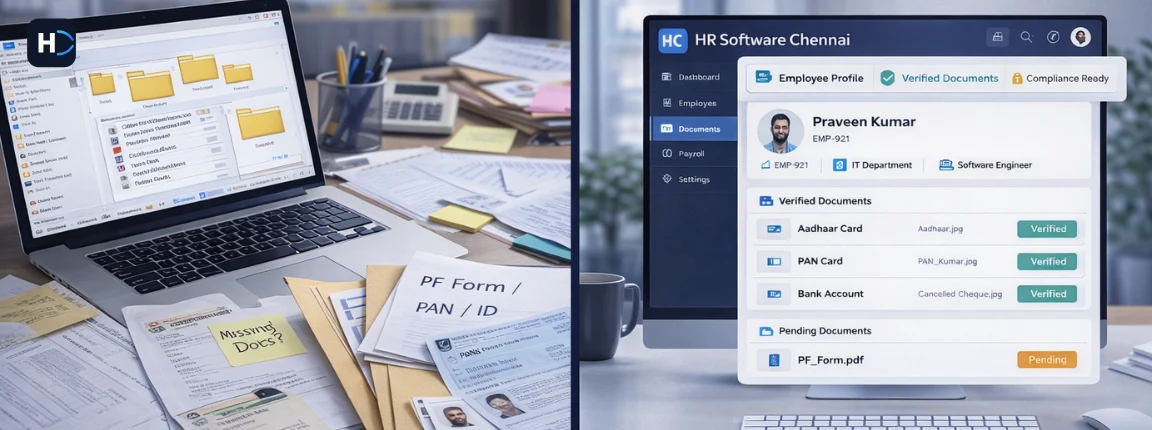
What good practice looks like: Every document filed against an employee record is tagged with a document type, an effective date, and an expiry date where applicable. The HRMS maintains a structured document repository where every employee’s complete record is accessible in one place.
- Identity documents
- Employment documents
- Statutory documents
- Compensation documents
- Performance documents
- Disciplinary documents
- Exit documents
4. Disciplinary and Performance Documentation
What gets missed: Informal conversations happen. A manager speaks to an employee about attendance. A warning is issued verbally. A performance improvement plan is discussed in a one-on-one. None of it is written down.
Why it matters: Tamil Nadu’s Industrial Disputes Act and the Shops and Establishments Act both require that disciplinary action follow a defined procedure. An employer who skipped steps, or who took them but did not document them, is exposed to reinstatement orders and back-wage liability.
What good practice looks like: Every disciplinary interaction is documented at the time it occurs, not reconstructed afterward. The complete record tells a coherent, defensible story.
- Verbal counselling note
- Written warning with acknowledgement
- Show cause notice and employee response
- Inquiry officer appointment and findings
- Final order and appeal response
5. Structured Onboarding and Exit Checklists
What gets missed: Onboarding checklists exist in theory. In practice, they are completed partially during the first week and then abandoned as the new joiner gets absorbed into their role. Exit checklists are even more inconsistent.
Why it matters: Incomplete onboarding creates compliance gaps and operational risks. Incomplete exit creates security risks, financial risks, and legal risks.
What good practice looks like: Onboarding and exit checklists are system-driven, not paper-driven. Each task has an owner and a deadline. The HRMS tracks completion status and sends reminders.
Onboarding checklist – minimum items:
- Identity and statutory document collection
- PF and ESI enrollment submission
- Bank account verification
- System access provisioning
- Asset issuance acknowledgement
- Policy acknowledgements
- Induction completion confirmation
Exit checklist – minimum items:
- Resignation receipt and acceptance
- Notice period confirmation or buyout agreement
- Asset return confirmation
- System access revocation confirmation
- Knowledge transfer completion
- Leave encashment calculation
- Loan and advance recovery confirmation
- Full and final settlement approval
- Relieving letter and experience certificate issuance
- PF transfer or withdrawal form submission
6. Data Retention and Destruction Policies
What gets missed: HR records are kept indefinitely because nobody has decided when they should be destroyed. Former employees’ personal data sits in shared drives and email archives years after departure. At the same time, statutory documents that must be retained are sometimes deleted too early.
Why it matters: India’s Digital Personal Data Protection Act 2023 requires that personal data be retained only for as long as necessary and then deleted. At the same time, destroying statutory records before the legal retention period expires creates compliance risk.
| Document Type | Minimum Retention Period | Applicable Law |
|---|---|---|
| Attendance / muster roll | 3 years | Tamil Nadu Factories Act / Shops Act |
| Wage register | 3 years | Payment of Wages Act |
| PF records | 5 years after last contribution | EPF Act |
| ESI records | 5 years | ESI Act |
| Accident register | 5 years | Factories Act |
| Employment contract | Duration of employment + 3 years | General legal practice |
| Disciplinary records | Duration of employment + 3 years | Industrial Disputes Act exposure |
| Tax records (Form 16, TDS) | 7 years | Income Tax Act |
What good practice looks like: A documented data retention policy that specifies retention periods for every document category, assigns responsibility for periodic review and destruction, and logs every destruction event.
7. Accessible Records for Employees, Not Just HR
What gets missed: Employee records are maintained for HR’s purposes, compliance, payroll, audits. Employees are rarely given structured access to their own records. They call HR for payslips, employment verification letters, or experience certificates.
Why it matters: Under India’s DPDPA 2023, employees have the right to access their own personal data held by their employer. This is also a service expectation that shapes how employees evaluate HR professionalism.
What good practice looks like: Employee self-service access to their own complete record through a secure mobile app or web portal. Document requests are submitted through the portal and fulfilled by HR within a defined SLA.
Putting It All Together: The Record Management Infrastructure
When all seven areas are addressed, employee record management transforms from a reactive filing function into a proactive governance system.
- Onboarding triggers a system-driven document collection checklist and payroll enrollment stays blocked until complete.
- Policy updates generate acknowledgement requests and completion is tracked and logged per employee.
- All documents are stored in a structured, searchable repository and the complete employee record is accessible in one click.
- Disciplinary interactions are documented in real time and the evidence trail is maintained automatically.
- Exit triggers a system-driven clearance checklist and final payment stays blocked until clearance is confirmed.
- Retention policies are applied automatically and documents are flagged for destruction review at the right time.
- Employees access their own records through self-service and HR is freed from routine document requests.
The measurable outcome:
Organizations that implement structured employee record management report a 70 to 80 percent reduction in document retrieval time, near-elimination of compliance gaps identified during statutory audits, and a significant reduction in HR time consumed by routine document requests.
Conclusion
Employee record management is not glamorous HR work. But it is the infrastructure on which everything else depends, payroll accuracy, statutory compliance, legal defensibility, and the employee experience of being treated as a professional by a professional organization.
Growing businesses in Chennai consistently underinvest in this infrastructure during their scaling phase, not because they do not understand its importance, but because there is always something more urgent. The audit is hypothetical. The legal dispute has not happened yet. The inspector has not visited.
Until they do.
The gaps described in this article are not difficult to close. They require clear policies, system support, and the organizational discipline to enforce checklists even when it would be faster to skip them. The investment is modest. The risk of not making it is not.
Takeaway:
The best time to build a proper employee record management system is before you need it. For a growing Chennai business, that means now, before the next 50 hires make the problem twice as hard to fix, before the first statutory audit makes the gaps undeniable, and before the first legal dispute makes the absence of documentation expensive.