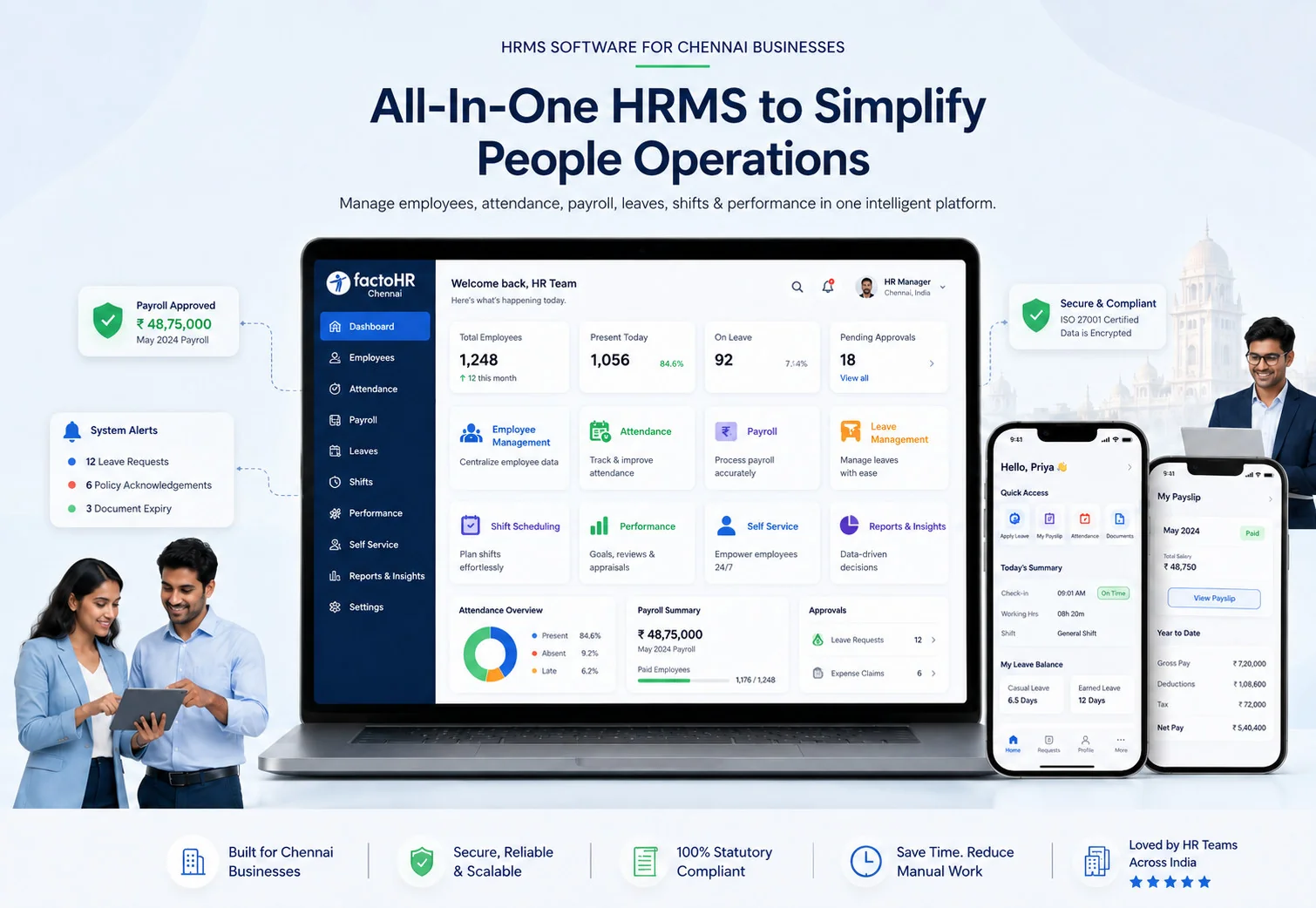

There is a moment in every growing Chennai business when the HR manager stops managing people and starts managing paperwork. The attendance register that used to take 20 minutes to reconcile now takes half a day. The payroll that one person handled comfortably at 40 employees is causing errors at 90. The leave tracker spreadsheet has been edited by four different people this month and nobody is sure which version is correct.
That moment is not a staffing problem. It is a systems problem. And the solution is not another HR hire, it is software.
The question most Chennai business owners and HR leaders wrestle with is not whether to move to HR software eventually. It is when. Too early, and the investment feels disproportionate to the problem. Too late, and the accumulated cost of manual errors, compliance gaps, and HR inefficiency has already exceeded what the software would have cost over the same period.
This article identifies the specific signals, operational, financial, and compliance-related, that tell a Chennai business it is time to move, what to expect from the transition, and how to choose the right platform for where the business is now and where it is going.
In summary:
Most Chennai businesses wait too long to move from manual HR to software. The decision point is not headcount alone, it is the intersection of workforce complexity, compliance exposure, payroll error frequency, and HR team capacity. For most growing businesses, that intersection arrives between 30 and 75 employees, well before it feels urgent.
Why Chennai Businesses Stay Manual Longer Than They Should
Understanding why businesses delay the move to HR software is as important as understanding when to make it. The delay is rarely irrational, it reflects real constraints and genuine uncertainties.
The four reasons Chennai businesses stay manual too long:
- The cost feels disproportionate at small scale: At 35 employees, a monthly software subscription can feel like overhead. What stays invisible is the cost of HR time being consumed by manual processes rather than strategic work.
- The problem does not feel urgent until it is critical: Manual HR systems degrade gradually. It is only when payroll disputes, statutory notices, or key HR resignations happen that the fragility becomes undeniable.
- Implementation feels disruptive: Businesses often underestimate how fast modern cloud-based HR platforms can be deployed and overestimate the disruption relative to the ongoing cost of staying manual.
- “We will do it when we have time”: There is never a convenient time to implement HR software. Waiting for a quiet moment usually means permanent deferral.
The 7 Signals That Tell You It Is Time
1. Payroll Errors Are Happening Every Month
What it looks like: Employees are raising salary queries after every payroll run. LOP deductions are wrong. Variable pay components are missing. New joiners and exits are being paid incorrectly. Each error takes hours to investigate, correct, and communicate.
Why it matters: Payroll errors are not just an administrative inconvenience, they are a trust signal. In Chennai’s competitive talent market, payroll reliability is a retention factor that HR leaders consistently underestimate.
The threshold: If your team is raising more than three payroll correction requests per cycle, or if HR is spending more than one full day per month investigating payroll errors, manual payroll has exceeded its viable operating limit.
What software does: Automates attendance consolidation, LOP calculation, pro-rata computation for mid-month joiners and leavers, and statutory deduction application.
2. Statutory Compliance Is Being Managed Reactively
What it looks like: PF challans are deposited late, ESI contributions are calculated incorrectly after increments, Tamil Nadu Professional Tax is applied at the wrong slab, or the muster roll has not been updated in the required format.
Why it matters: Tamil Nadu’s regulatory environment is not forgiving of reactive compliance. A single PF inspection that finds systemic ECR errors can result in meaningful penalties and trigger a full audit of historical records.
The threshold: If HR cannot confirm at any moment whether ESI contributions are correct, overtime is within Factories Act limits, and all PF nominations are on file, your compliance posture has moved from managed risk to unmanaged exposure.
What software does: Applies statutory rules automatically and generates ECR files, ESI returns, and PT challans ready for submission.
3. HR Is Spending More Time on Administration Than on People
What it looks like: The HR manager’s day is dominated by attendance correction emails, leave balance queries, payslip reprint requests, and month-end reconciliation. Strategic HR work is constantly deferred.
Why it matters: In Chennai’s talent market, HR’s strategic contribution, recruitment, retention, compliance, workforce planning, matters directly to business performance. An HR function trapped in administration cannot deliver that contribution.
The threshold: If your HR team is spending more than 50 percent of their time on tasks that could be automated, you are paying strategic salaries for administrative work.
What software does: Automates routine attendance, leave balances, payslips, and compliance preparation so HR can focus on work that requires human judgment.
4. You Are Operating Across Multiple Locations or Shift Patterns
What it looks like: The business has a head office in Chennai and another operational location elsewhere, or a factory running multiple shifts alongside an office. Each location has different attendance policies, holiday calendars, and work rules.
Why it matters: Multi-location, multi-shift operations are where manual HR systems break down fastest. Complexity, data volume, and rule variation drive error rates up quickly.
The threshold: If your business has more than one location or more than one shift pattern, the complexity justification for HR software exists independent of headcount.
What software does: Manages multiple locations, shift patterns, work rules, and holiday calendars within one system, with each location’s rules applied correctly.
5. Employee Self-Service Expectations Are Not Being Met
What it looks like: Employees are emailing HR for payslips, leave balances, and employment verification letters. Routine requests take days and follow-ups.
Why it matters: Chennai’s workforce, especially in IT, ITES, and professional services, expects digital-first HR support. Slow, manual service affects employer brand and retention.
The threshold: If HR is receiving more than five routine document or information requests per week per 50 employees, the self-service gap has reached the point where software pays for itself.
What software does: Gives employees access to payslips, leave balances, and employment letters directly through self-service portals and mobile apps.
6. Key-Person Dependency Has Become an Operational Risk
What it looks like: One HR person knows how payroll works, where the biometric data is stored, and which allowances are exempt from PF. If that person goes on leave or resigns, payroll slows or breaks.
Why it matters: Institutional knowledge that lives in one person’s head is an operational liability. For compliance, a new HR person inheriting an undocumented manual process starts from a position of unknown risk.
The threshold: If the honest answer to “what happens to payroll if our HR manager resigns tomorrow?” is “we would struggle significantly,” key-person risk is already material.
What software does: Encodes payroll rules, statutory requirements, and workflow logic in the system, not in an individual’s memory.
7. You Are Approaching or Have Crossed Key Statutory Thresholds
What it looks like: The business recently crossed or is nearing thresholds that trigger ESI, EPF, gratuity, Factories Act, Standing Orders, or POSH obligations.
Why it matters: Each threshold adds record-keeping, filing, and reporting requirements. Crossing them with a manual HR process creates a period of elevated compliance risk.
| Threshold | Obligation Triggered | Manual HR Risk |
|---|---|---|
| 10+ employees | ESI registration and monthly contributions | ESI threshold monitoring done manually, errors likely |
| 20+ employees | EPF registration and monthly ECR filing | ECR generation from manual data, high error risk |
| 50+ employees | Gratuity Act applicability | Gratuity liability accumulation not tracked without software |
| 100+ employees (manufacturing) | Factories Act full applicability | Form 25, overtime register, accident register required |
| 100+ employees (commercial) | Standing Orders certification required | Policy documentation and compliance formalized |
| 500+ employees | Internal Complaints Committee mandatory | POSH compliance tracking requires formal system |
The transition window: The best time to implement HR software is just before crossing a statutory threshold, not just after.
What to Expect From the Transition
Timeline for a Chennai Business (50 to 200 Employees)
| Phase | Duration | Key Activities |
|---|---|---|
| Discovery and configuration | Weeks 1-2 | Document work rules, leave policies, pay structures, and statutory obligations |
| Data migration | Week 3 | Employee master data, salary structures, YTD figures, leave balances |
| Parallel run | Weeks 4-5 | Run manual and software payroll simultaneously and validate outputs |
| Go-live | Week 6 | First live payroll processed entirely through software |
| Stabilization | Weeks 7-10 | Exception handling, configuration fine-tuning, manager training |
What the First Three Months Look Like
The first month will surface configuration gaps, work rules that were not fully documented, edge cases that the setup did not anticipate. This is expected. By the second month, the system usually runs smoothly with exceptions handled confidently. By the third month, the HR team has measurably more time and the payroll run becomes a structured review exercise rather than a manual assembly project.
Choosing the Right Platform for a Chennai Business
Not every HR software platform is suited to every Chennai business. The right choice depends on size, industry, workforce complexity, and budget.
| Platform | Best For | Chennai Fit |
|---|---|---|
| factoHR | All business sizes, SMEs to enterprises | India-first platform with attendance, payroll, compliance, self-service, biometric integration, multi-site support, and Tamil Nadu statutory fit |
| greytHR | SMEs, India compliance focus | Strong TN PT, PF ECR, and ESI support; widely used across Chennai |
| Keka HR | Mid-market, IT and services | Strong self-service and modern UX; popular in OMR and Tidel Park companies |
| Zoho Payroll | Small businesses, Zoho ecosystem | Cost-effective and suitable for early-stage Chennai businesses |
| Darwinbox | Large enterprises, complex rules | Enterprise-grade fit for 500+ employee Chennai operations |
| HROne | Mid-market, manufacturing | Strong shift and attendance management; suited to Ambattur and Sriperumbudur units |
| sumHR | Startups and fast-growing teams | Lightweight and quick to deploy; suited to early-stage Chennai startups |
Three questions to ask every vendor before shortlisting:
- Can you demonstrate Tamil Nadu Professional Tax calculation and PT challan generation live?
- Does your platform integrate with the biometric hardware we currently use?
- Can you provide a reference from a Chennai-based company of similar size and industry?