Guide Overview
What Is the Payroll Process in India?
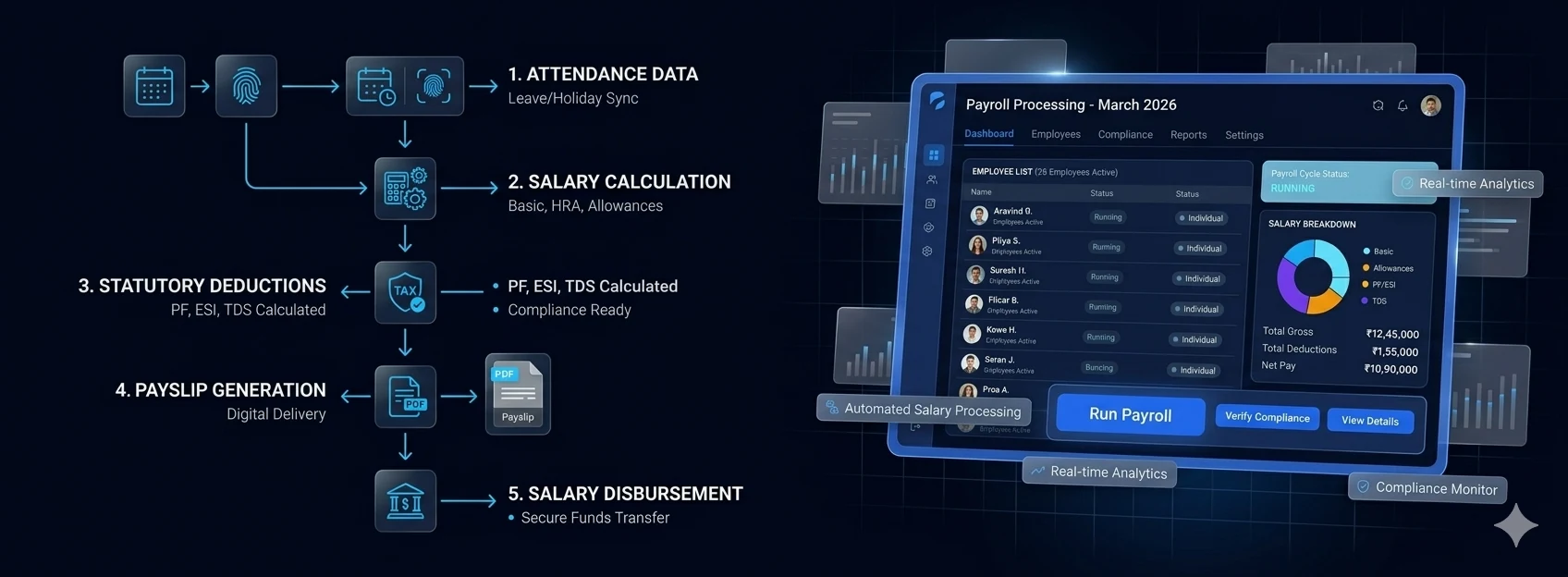
In India, the payroll process is heavily regulated by both Central and State laws. It is not merely a financial transaction but a legal obligation to ensure social security contributions are met. For payroll for Indian businesses, this involves a three-phase approach: Pre-Payroll, Actual Payroll, and Post-Payroll activities — each with its own compliance obligations under EPF, ESI, Professional Tax, and the Income Tax Act.
Whether you manage a manufacturing unit in Chennai or a tech startup in Tamil Nadu, following a standardised payroll cycle is the only way to avoid penalties and employee dissatisfaction.
The 8 Core Payroll Processing Steps
Step 1
Establish Payroll Policy & Salary Structure
The first of all payroll processing steps is defining your framework. A clearly documented salary policy prevents disputes, simplifies audits, and ensures every subsequent step runs predictably.
- Action: Define pay scales, HRA percentages (50% of Basic for metro cities like Chennai), and leave-encashment rules.
- Align: Ensure your payroll software reflects the latest labour codes and applicable wage revisions.
- Document: Formalise the salary structure in employment contracts and the HR policy manual.
Step 2
Input Collection — Attendance & Leave Data
Accurate salary processing is impossible without precise attendance data. This step consolidates all inputs that affect payable days before the calculation engine runs.
- Action: Consolidate attendance logs, biometric data, and Loss-of-Pay (LOP) days from the previous month.
- Integrate: Connect your attendance management software directly to the payroll engine to eliminate manual data entry.
- Review: Verify approved leaves, overtime hours, shift allowances, and any comp-off balances before closing the attendance cycle.
Step 3
Calculation of Gross Salary
Payroll calculation in India starts with total earnings before any deductions. Gross salary must be computed accurately because all subsequent statutory deductions are derived from it.
- Formula: Basic + HRA + Conveyance + Medical Allowance + Special Allowance + Performance Bonus
- Validate: Confirm that variable pay (incentives, commissions) is approved and correctly mapped to the current period.
- Check: Ensure rejoining employees, new hires, and mid-month exits are prorated correctly.
Step 4
Statutory Deductions & Tax Compliance
This is where most businesses face audit risk. Every deduction below must be applied precisely — errors here attract statutory penalties and employee grievances. For a detailed breakdown, see our guide on 7 payroll checks every HR team should automate.
- EPF: 12% of Basic salary (Employee share) — applicable where Basic ≥ ₹15,000/month
- ESI: 0.75% of Gross salary for employees earning below ₹21,000/month
- Professional Tax: Based on Tamil Nadu state slabs (e.g., ₹208–₹1,250 semi-annually for Chennai)
- TDS: Calculated based on the employee’s chosen tax regime (Old vs. New) and submitted investment declarations
Step 5
Final Net Pay Computation
Once all statutory and voluntary deductions are stripped from the gross, you arrive at the employee’s take-home salary. This must be computed individually for every employee in the register.
Formula: Net Salary = Gross Salary − (EPF + ESI + Professional Tax + TDS + Loan Deductions + Advance Recovery)
- Verify that loan repayment amounts match the approved schedule.
- Apply salary advance recoveries only for the agreed period.
- Flag any negative net salary cases for manual review before disbursement.
Step 6
Payroll Verification & Approval
Before disbursement, a Payroll Register or Variance Report must be generated to compare the current month’s payout against the previous month. This step prevents costly errors from reaching bank accounts.
- Run variance reports: Flag employees with salary changes above a defined threshold (e.g., ±10%).
- Multi-level approval: HR Manager → Finance Controller → CFO sign-off for enterprises above 50 employees.
- Freeze payroll: Lock the payroll register once approved to prevent unauthorised edits.
Step 7
Salary Disbursement & Payslip Distribution
Disbursement should occur between the 1st and 7th of the following month for most Indian businesses. Digital payslips must be issued simultaneously for full transparency.
- Disbursement: Bulk-upload the salary file to your corporate bank portal (NEFT/RTGS/IMPS).
- Payslips: Issue digital payslips clearly showing Basic, HRA, all allowances, PF contribution, ESI deduction, Professional Tax, and TDS.
- Record: Archive all payslips and bank acknowledgements for minimum 5 years as required by Indian labour law.
Step 8
Post-Payroll Compliance Filing
The payroll cycle is not complete until all statutory filings are submitted. Delays attract interest and penalties under each respective Act. For Chennai businesses managing multi-location workforce compliance, this step is the most time-critical.
- PF & ESI: Deposit by the 15th of the following month via the EPFO Unified Portal and ESIC Portal
- TDS (Section 192): Deposit by the 7th of the following month and file quarterly TDS returns (Form 24Q)
- Professional Tax: File monthly/semi-annual returns with the Tamil Nadu Commercial Tax Department
- GSTR Reconciliation: Ensure salary expenses and reimbursements reconcile with GST records for audit readiness
Real-World Payroll Calculation Table
Using a standard payroll calculator for a typical Chennai-based professional illustrates how each step above translates into actual numbers:
| Payroll Component | Amount (INR) | Category |
|---|---|---|
| Basic Salary | ₹25,000 | Core Earning |
| HRA (50% of Basic — Metro) | ₹12,500 | Allowance |
| Special Allowance | ₹5,000 | Allowance |
| Gross Salary | ₹42,500 | Total Earnings |
| Employee PF (12% of Basic) | − ₹3,000 | Statutory Deduction |
| ESI (N/A — Gross > ₹21,000) | ₹0 | Statutory Deduction |
| Professional Tax (Tamil Nadu) | − ₹208 | State Tax |
| TDS (estimated monthly) | − ₹1,000 | Income Tax |
| Net Salary (Take-Home) | ₹38,292 | Final Payout |
Note: TDS amount is indicative. Actual TDS depends on the employee’s annual income, tax regime, and declared deductions under 80C/80D.
Common Mistakes in the Payroll Process
Even experienced HR teams make predictable errors that lead to compliance notices. The most frequent include:
- Incorrect Professional Tax application: Failing to apply the correct Tamil Nadu PT slabs versus other states for employees working across multiple locations.
- Delayed statutory filing: Missing the 15th-of-the-month deadline for PF/ESI deposits triggers interest at 12% per annum under the EPF Act.
- Manual salary overrides: Changing salary values in Excel without an audit trail creates liability during labour inspections.
- Skipping the variance check: Processing payroll without comparing against the previous month allows ghost employees and duplicate payments to pass undetected.
- Ignoring mid-month exits: Not prorating salary and deductions for resigned or terminated employees creates both overpayment and statutory errors.
Our post on how HR software reduces payroll and attendance errors covers these in detail with real-world Chennai examples.
Why Automated Payroll Software Is the Solution
For businesses scaling their workforce, manual entry is a liability — not a process. Modern payroll software in Chennai turns these 8 payroll processing steps into a single-click monthly operation, ensuring your payroll cycle is always compliant with regional labour laws, Tamil Nadu PT slabs, and central statutory requirements.
Auto-Deduction Engine
PF, ESI, PT, and TDS are calculated automatically based on current statutory rates — no manual formulas, no errors.
Attendance Integration
Direct sync from biometric attendance systems eliminates manual data entry at Step 2.
Variance Reports
Month-on-month comparison reports flag anomalies automatically — replacing the manual variance check in Step 6.
Compliance Reminders
Built-in filing deadline reminders for PF, ESI, TDS, and PT ensure Step 8 is never missed.
Conclusion
The 8 payroll processing steps above form a closed loop — each step depends on the accuracy of the previous one. Businesses that standardise this sequence, automate statutory deductions, and maintain a complete audit trail are not just legally safe — they build employee trust and operational efficiency at the same time. For Chennai businesses looking to streamline the entire cycle, an integrated HR and payroll platform is the most reliable path to zero-error, on-time payroll every month.