Self-Assessment
The employee rates their own performance against agreed KPIs and KRAs before the review cycle opens. Self-ratings establish context for manager feedback and reduce confrontational conversations.
Set clear KRAs, track progress with intuitive OKR tools, and execute 360-degree appraisals effortlessly. Optimized for the unique compliance needs of Chennai-based businesses.
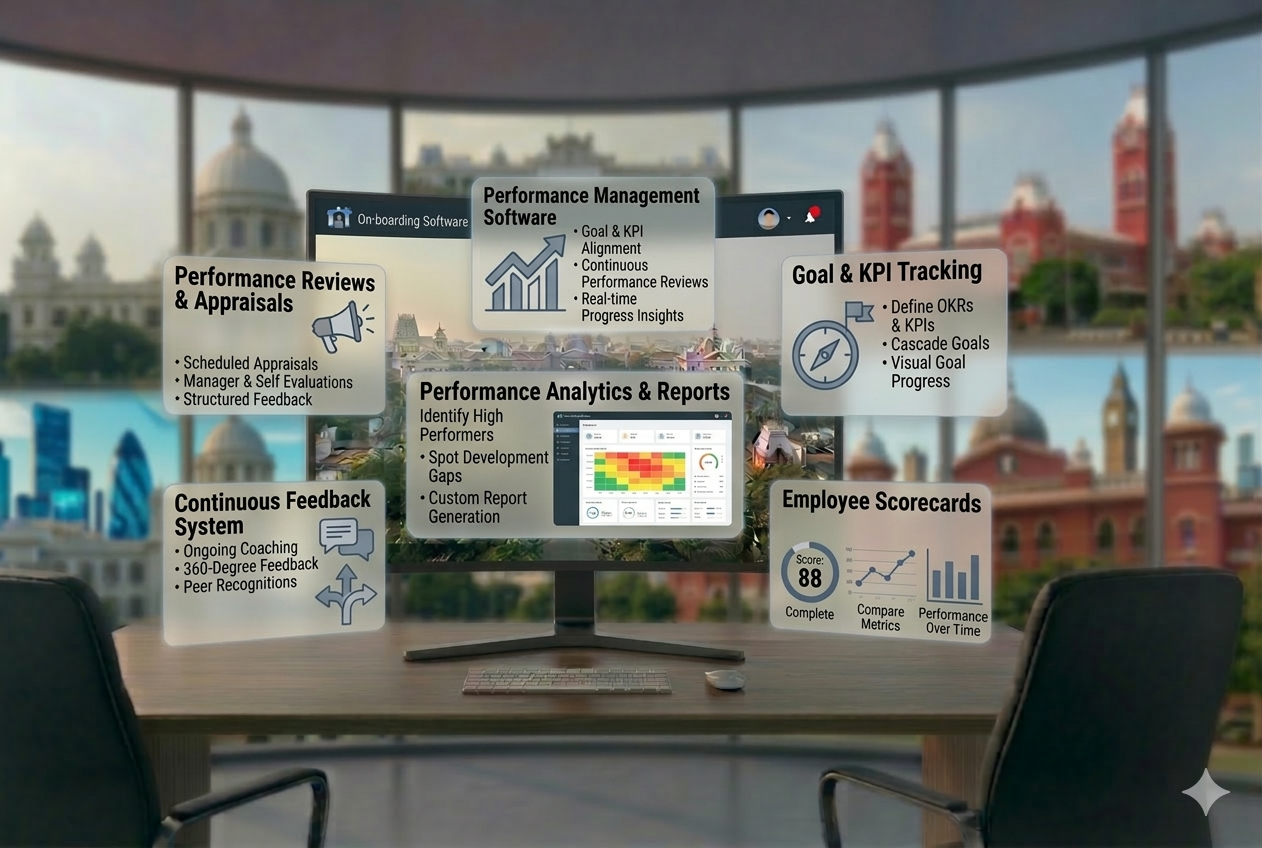







Performance management software (also called a PMS) helps organisations set KPIs and KRAs, run 360-degree appraisal cycles, track OKR progress quarterly, and capture continuous feedback - replacing paper-based annual reviews. Performance scores link directly to salary increments and promotion eligibility. Chennai businesses using automated PMS reduce appraisal cycle time from 6 weeks to 6 days.
Traditional annual appraisals in Chennai companies rely on a single manager's opinion - creating rating biases, blind spots, and employee distrust. 360-degree reviews collect feedback from every direction simultaneously.
The employee rates their own performance against agreed KPIs and KRAs before the review cycle opens. Self-ratings establish context for manager feedback and reduce confrontational conversations.
Direct manager rates the employee against KPIs and adds qualitative notes. Peer feedback from 3-5 colleagues reveals team dynamics that managers cannot see - collaboration, communication, and contribution all rated separately.
Skip-level and cross-functional raters add strategic perspective and project-level input. All five feedback streams consolidate into a single performance score - managers make more informed decisions, employees receive more credible feedback.
OKR (Objectives and Key Results) is the goal-setting framework used by Google, Freshworks, and thousands of Chennai IT and product companies. Our PMS supports both KPI/KRA-based appraisals and OKR-based goal tracking in the same platform.
Standard for manufacturing units in Ambattur, Guindy, and Oragadam, BFSI companies, and traditional sectors. Annual KRA/KPI appraisals tied to production targets, attendance management software, and role-specific metrics. Increment slabs configured once - applied at year end.
Preferred by HR software for IT companies, startups, and SaaS companies on OMR and Tidel Park. Quarterly OKR cycles with weekly check-ins. Company Objectives cascade to team Key Results and individual OKRs - every employee's work visibly connected to business priorities.
Chennai businesses run different appraisal cycles depending on industry, team size, and HR maturity. Our PMS software supports all standard appraisal formats.
| Appraisal Type | Cycle | Best For | Key Feature |
|---|---|---|---|
| Annual Appraisal | Yearly | Manufacturing, BFSI, traditional sectors | KRA/KPI ratings consolidated over 12 months |
| Mid-Year Review | 6-monthly | All sectors | Interim check-in to adjust goals and flag at-risk employees |
| Continuous Performance | Monthly/Quarterly | IT companies, startups, OMR | Real-time feedback, OKR check-ins, no annual crunch |
| Project-Based Appraisal | Per project | IT services, consulting, project manufacturing | Performance reviewed at project end, not calendar date |
| 360-Degree Review | Annual/Bi-annual | Senior employees, leadership development | Multi-rater: self, manager, peers, skip-level, cross-functional |
When an employee consistently scores below expectations, a structured Performance Improvement Plan (PIP) is the legally sound and professionally appropriate response. Terminating without documented process exposes Chennai businesses to labour tribunal risk.
Every PIP step is time-stamped, signed by both manager and employee, and stored in the audit trail - protecting the business and giving the employee a fair, transparent improvement process.
Performance data has no business value if it sits in a separate system from payroll. Our platform connects performance review scores directly to the salary revision cycle.
Chennai's workforce has specific performance management dynamics that national software platforms don't address. Our PMS is configured for all four Chennai workforce types.
OKR-based quarterly review cycles with emphasis on technical skill growth and project delivery metrics. Continuous check-ins replace annual appraisals. OKR scores feed into increment processing automatically.
KRA-based annual appraisals tied to production targets, safety records, and attendance compliance. Bell curve normalisation across shifts. Increment slabs calculated from shop floor performance scores.
Competency-based appraisals with clinical skill assessment and patient outcome metrics. 360-degree reviews for senior clinical staff. Performance linked to specialisation development pathways.
Simplified annual reviews tied to attendance compliance, production quality, and overtime management. Bulk appraisal processing for large factory headcounts. PIP workflows configured for productivity thresholds.
Our PMS software covers the complete performance cycle - KRA and KPI setting, OKR alignment, 360-degree multi-rater reviews, continuous check-in feedback, and performance-linked increment processing.
Keep performance conversations continuous so issues and progress are visible earlier.
Make development actions accountable by connecting review outcomes to measurable next steps.
See where review cycles slow down, how ratings trend, and where managers need support.
Manufacturing units in Ambattur use annual KRA/KPI appraisals tied to production targets. IT companies on OMR use quarterly OKRs with weekly check-ins. Our PMS software supports all three frameworks simultaneously - configure the right performance model for each department without switching between systems.
Annual reviews where one manager rates one employee create recency bias, halo effects, and employee distrust. Our 360-degree review collects input from self, manager, peers, skip-level, and cross-functional colleagues - giving every employee a complete, credible picture of their performance from every direction.
When your appraisal cycle closes, performance ratings automatically calculate increment slabs, route for Finance approval, and update payroll - without manual export or pivot tables. Increment processing that takes 5 days of manual work completes in 4 hours.
Terminating an underperforming employee without documented process exposes Chennai businesses to labour tribunal claims. Our PIP workflow creates a timestamped, signed, and auditable performance improvement process - specific targets, regular check-ins, manager sign-offs, and final outcome documentation.
Chennai companies spending 6 weeks every January on a rushed appraisal that changes nothing can migrate to continuous performance management in 30 days. Set up KPI/KRA templates, configure 360-degree review flows, activate monthly check-ins, and link ratings to payroll - our employee onboarding software team handles the entire PMS configuration.
Run payroll, manage attendance, and approve workflows from any device. Manage HR operations instantly and securely whether you’re in the office, at home, or on the move - without missing anything.
Seamlessly integrate with your existing ERP, accounting, communication, and verification systems - without disrupting your current workflows.
Performance management software (PMS - Performance Management System) is a system that helps organisations set employee goals, track KPIs and KRAs, run appraisal cycles, capture 360-degree feedback, and link performance outcomes to salary increments and promotions. Also called a Performance Management System, it replaces annual paper-based reviews with continuous, data-driven performance conversations between employees and their managers throughout the year.
KRA (Key Result Area) defines the specific area where an employee is responsible for delivering results - such as Sales, Customer Service, or Product Quality. KPI (Key Performance Indicator) is the measurable metric within that KRA - such as Revenue Generated, CSAT Score, or Defect Rate. Performance management software allows HR teams to configure both KRAs and KPIs for every role and then tracks achievement against them during appraisal cycles.
A 360-degree review collects performance feedback from multiple sources simultaneously - the employee's self-assessment, direct manager, peers, skip-level manager, and cross-functional collaborators. Unlike single-manager appraisals, 360-degree reviews eliminate rating bias and give employees a complete picture of their strengths and development areas. Performance management software automates 360-degree review distribution, reminder sequences, and score consolidation across all raters.
OKRs (Objectives and Key Results) are a quarterly goal-setting framework where company-level Objectives cascade to team and individual Key Results. Unlike annual KPIs, OKRs create 90-day cycles with frequent check-ins. Chennai IT companies and startups prefer OKRs for faster course correction and team alignment. Traditional sectors use KPI/KRA-based annual appraisals. Modern performance management software supports both frameworks in the same platform.
A Performance Improvement Plan (PIP) is a structured, time-bound document given to employees who consistently score below performance expectations. It sets specific improvement targets, a 30-90 day timeline, and regular check-in milestones. Chennai businesses use PIPs to create a documented, fair process before taking disciplinary action - protecting the organisation from labour tribunal claims and giving the employee a transparent improvement pathway.
Performance management software connects appraisal scores to the payroll increment cycle. HR configures increment slabs - for example, a 5/5 rating triggers a 15% increment, 4/5 triggers 10%. When the appraisal cycle closes, the system calculates revised salaries in bulk and routes them for Finance approval. This eliminates manual increment calculation errors and makes the salary revision process fully auditable.
Continuous performance management replaces the once-a-year appraisal with regular check-ins - monthly 1:1 meetings, real-time feedback, and quarterly goal reviews. Rather than a single score at year end, employees receive ongoing performance signals. Chennai IT companies and startups adopt continuous performance management because quarterly OKR cycles and monthly check-ins align better with fast-changing project work than an annual review completed in January.
Performance management software in Chennai typically costs ₹50 to ₹200 per employee per month when part of an HRMS suite. Standalone PMS tools start at ₹80-120 per employee. Most vendors include performance management as a module within their core HRMS - so the marginal cost is minimal compared to the productivity, retention, and compliance value of structured appraisals. Most vendors offer a free trial or demo.
See how performance management software simplifies goals, review cycles, feedback, and employee development.