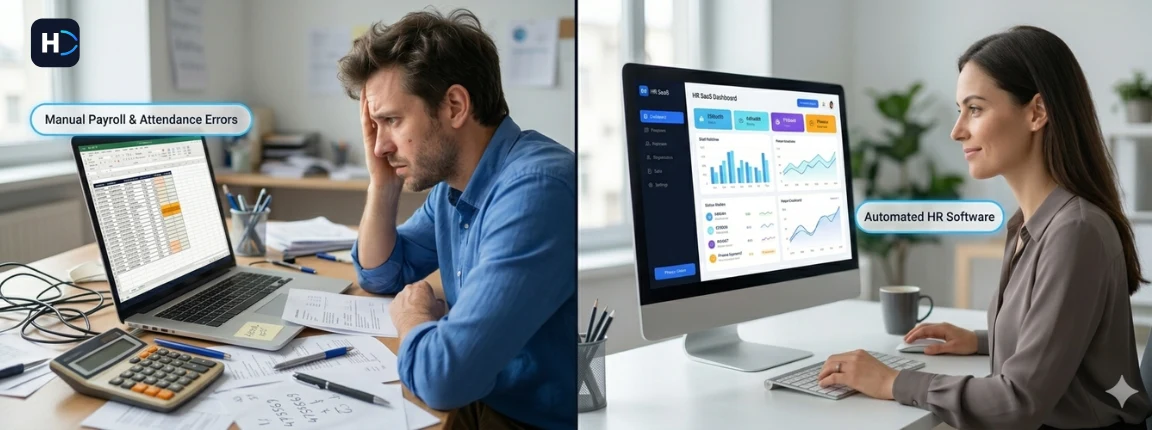

The Cost of Getting Payroll and Attendance Wrong
If your HR team in Chennai is still manually tallying attendance registers, cross-checking punch-in logs with spreadsheets, or correcting payroll every month before the salary run, you are not alone. But you are leaving money, time, and employee trust on the table. Payroll and attendance errors are among the most costly and demoralising problems facing small and mid-size businesses across the city, from Guindy IT parks to Ambattur industrial estates.
This guide explains exactly how modern attendance and payroll software solves these challenges — with specific features, real-world scenarios relevant to Chennai’s labour market, and answers to the questions HR managers and founders ask most often.
Integrated attendance and payroll software reduces payroll errors by automating salary calculations, statutory deductions like PF, ESI, and PT, and leave deductions. It eliminates attendance errors by connecting biometric devices, mobile apps, or web portals to a single real-time record, removing manual data entry entirely.
In Chennai specifically, the challenge is magnified by a multi-shift workforce culture common in manufacturing and IT, diverse employee categories including on-roll staff, contract labour, and apprentices, and the need to comply with Tamil Nadu Professional Tax alongside central PF and ESI obligations.
What Causes Payroll and Attendance Errors?
Understanding root causes helps you evaluate whether a given attendance and payroll software solution actually addresses them. The most common sources of error fall into four categories:
| Category | Common Errors | Business Impact |
|---|---|---|
| Manual attendance | Buddy punching, late entries, missed records | Ghost payroll, overtime disputes |
| Spreadsheet payroll | Formula errors, version conflicts, stale leave balances | Underpayment, overpayment, compliance risk |
| Disconnected systems | Leave not reflected in salary, LOP miscalculated | Employee trust issues, rework |
| Statutory compliance | Wrong PF slab, PT rate mismatch, ESI ceiling errors | Penalty, legal liability |
The third category — disconnected systems — is where most Chennai businesses lose the most time. When attendance data lives in a biometric device, leave data lives in email threads, and payroll runs in a spreadsheet, the HR team manually bridges all three every month. That manual bridge is where errors enter the process.
Why Attendance and Payroll Software Must Be Integrated
Many businesses in Chennai run attendance management and payroll as entirely separate processes — one handled by the admin team, the other by finance. This split creates a data handover gap that is responsible for the majority of salary errors. Integrated attendance and payroll software closes that gap by making attendance data, leave approvals, and payroll calculations part of one continuous workflow.
The Data Gap Between Standalone Systems
When attendance software and payroll software are not connected, a chain of manual steps bridges them every month. HR collects attendance punch data from the biometric device, exports it to a spreadsheet, cross-references leave applications approved in a different system, calculates Loss of Pay manually, and then enters final working-day counts into the payroll tool. Each handover point is an opportunity for an error — a transposed number, a missed leave record, or a miscounted Sunday.
For a Chennai manufacturing company with 200 employees across three shifts, this monthly consolidation exercise can take two to four days. For an IT firm managing variable pay, overtime, and shift allowances, the margin for spreadsheet error is even higher.
How Integrated Attendance and Payroll Software Works
Cloud-based payroll and attendance software replaces those manual handover steps with an automated data pipeline. The flow works like this:
- Attendance capture: Employees clock in via biometric device, face recognition terminal, mobile GPS app, or web portal. Data is recorded in real time with no manual re-entry.
- Shift and overtime calculation: The system matches punches to the assigned shift, calculates overtime, flags missing punches, and routes regularisation requests to managers automatically.
- Leave sync: When a leave request is approved, the attendance ledger updates instantly. Casual leave, earned leave, and sick leave deduct from the running balance without HR intervention.
- Loss of Pay calculation: When leave balance runs out, LOP is calculated by the system based on the month’s working days — not by a formula in a shared spreadsheet.
- Payroll engine input: At month-end, the payroll engine pulls verified attendance days, approved leave, LOP count, overtime hours, and shift allowances directly — no manual data entry, no file transfers.
- Salary computation: Gross salary is calculated using configured pay heads. Statutory deductions (PF, ESI, PT, TDS) are applied automatically. Net payable is produced and flagged for HR approval before release.
When attendance data and payroll processing run in the same system, the monthly payroll cycle for a 100-employee Chennai business shrinks from two or three days of consolidation work to under two hours of review and approval. Errors that used to slip through manual handovers simply no longer have a point of entry.
What to Look for in Attendance and Payroll Software Integration
Not all HR platforms integrate attendance and payroll with equal depth. When evaluating attendance management and payroll software for your Chennai team, check these specific integration points:
- Real-time leave balance deduction: Leave approvals should update attendance and payroll records instantly, not in a nightly batch.
- LOP auto-calculation: The system should calculate Loss of Pay based on attendance days and approved leave without any manual input from HR.
- Overtime-to-payroll mapping: Overtime hours captured in attendance should flow directly into pay head calculations, especially for manufacturing and factory workforces.
- Shift allowance automation: Night shifts, rotational shifts, and weekend duty should trigger configured allowances automatically when attendance data confirms the shift was worked.
- Arrears handling: If attendance data is corrected after payroll is processed, the system should calculate arrears for the next cycle automatically.
Core HR Software Features That Eliminate Attendance and Payroll Errors
1. Automated Attendance Capture
Modern attendance and payroll software integrates with biometric devices, face-recognition terminals, mobile GPS check-in, and web-based portals. The moment an employee clocks in, the data flows directly into the HR system with no transcription and no manual entry.
- Biometric integration with devices such as ZKTeco, Essl, and Suprema is supported by most leading Indian HR platforms.
- Geo-fenced mobile attendance suits Chennai field sales teams and executives working from client offices.
- Shift management supports IT companies running 24/7 operations across OMR and Sholinganallur.
- Auto-regularisation workflows let employees correct missed punches with manager approval, creating a tamper-evident audit trail.
How do I stop buddy punching in my Chennai office?
Use attendance and payroll software with biometric or face-recognition attendance linked directly to the payroll engine. Any mismatch between device data and shift schedule flags an exception automatically, making proxy attendance nearly impossible.
2. Leave Management Integrated With Payroll
The most frequent payroll error in Indian organisations is incorrect Loss of Pay calculation. This happens when leave applications, approvals, and payroll processing run on separate systems that are never in sync.
- HR software maintains a single leave ledger that deducts from balances in real time on approval.
- Paid leave, casual leave, sick leave, and earned leave follow company policy rules coded once into the system.
- LOP is automatically calculated when leave balance is exhausted, and the payroll engine picks it up without manual input.
- Chennai-specific holidays such as Pongal, Tamil New Year, and Karthigai Deepam can be configured in the holiday master for accurate working-day calculations.
3. Payroll Engine With Statutory Compliance
This is where payroll software with attendance integration delivers the clearest return on investment for Chennai businesses. The payroll engine automates every calculation that a finance or HR executive would otherwise do by hand.
| Statutory Obligation | How Attendance and Payroll Software Handles It |
|---|---|
| Provident Fund (PF) | Auto-calculates 12% employer and 12% employee on basic, applies wage ceiling, and generates ECR file for EPFO portal. |
| ESI | Checks gross salary against the Rs. 21,000 threshold and applies 3.25% employer plus 0.75% employee contribution automatically. |
| Professional Tax (TN) | Applies Tamil Nadu PT slabs automatically and handles half-yearly filings with challan generation. |
| TDS / Income Tax | Computes projected annual tax, applies declared investments, and generates Form 16 and Form 24Q. |
| Gratuity | Auto-provisions monthly and calculates eligibility on five-year completion. |
4. Real-Time Payroll Preview and Error Flagging
Before salary is disbursed, good attendance and payroll software runs a validation engine that flags anomalies — a salary that is 40% higher than last month, an employee showing zero attendance, or a new joiner with no bank details on record.
- Variance reports highlight unusual changes across the team, making outliers visible before payout.
- Checklist-based payroll lock prevents processing without completing mandatory review steps.
- Pre-payroll audit logs stay ready for statutory inspections and internal audits.
5. Employee Self-Service Portal
A significant portion of payroll queries in any Chennai office comes from employees asking HR to resend payslips, correct an address, or explain a deduction. Self-service portals in integrated attendance and payroll software put this control directly in employees’ hands.
- Employees download payslips, Form 16, and investment declarations without contacting HR.
- Leave applications, attendance regularisation, and reimbursement claims flow through a mobile app.
- Managers approve or reject requests from their phones, keeping the attendance-to-payroll workflow moving without email delays.
What is employee self-service in attendance and payroll software?
A self-service portal is a secure web or mobile interface where employees can view their attendance records, apply for leave, download payslips, submit investment declarations, and raise queries without contacting HR directly. It reduces HR’s administrative workload by 30 to 40 percent in most deployments.
Why Chennai Businesses Face Specific Payroll and Attendance Compliance Challenges
Tamil Nadu Professional Tax
Tamil Nadu levies Professional Tax on a half-yearly basis with slabs distinct from those in Karnataka or Maharashtra. Incorrect deduction exposes employers to penalties. Attendance and payroll software pre-loaded with TN PT configurations updates automatically when rates change and generates the required challan, removing the risk of manual slab misapplication.
Multi-Shift Manufacturing Workforce
The Ambattur, Perungudi, and Sriperumbudur industrial corridors employ large shift-based workforces. Night shift allowances, overtime calculations under the Factories Act, and compensatory off tracking are all areas where manual HR processes regularly fail. Biometric attendance payroll software codifies shift rules once and applies them consistently to every attendance record, every cycle.
Contract Labour Regulation
Many Chennai companies engage contract workers through staffing agencies. The Contract Labour Regulation framework requires principal employers to maintain records and ensure statutory compliance even for contract staff. HR software with contractor management modules helps principal employers track headcount, verify statutory deductions, and maintain required compliance records.
IT and ITES Workforce Complexity
Chennai’s IT corridor stretching from Anna Salai through Velachery to OMR employs professionals under variable pay structures — base salary, performance bonuses, and shift allowances. Cloud-based attendance and payroll software handles variable components through formula-based pay heads, computing the right amount for every combination of attendance, leave, and performance input without manual adjustment.
How to Choose the Right Attendance and Payroll Software for Your Chennai Team
When shortlisting payroll and attendance software for a Chennai business, evaluate each vendor against these criteria before committing to a demo or trial:
| Evaluation Criterion | What to Look For |
|---|---|
| Indian statutory compliance | Auto-updates for PF, ESI, TDS, and Tamil Nadu PT with integrated challan generation — no manual rate editing after a budget change. |
| Attendance device integration | Native support for biometric brands common in Chennai: ZKTeco, Essl, Suprema, Realtime, and HID. Check if the sync is real-time or batch. |
| Attendance-to-payroll data flow | Verify that leave approvals, LOP, overtime, and shift data update payroll automatically — no manual file export between systems. |
| Localisation | Tamil language interface option, Indian date formats, and bank-ready NEFT and RTGS payout files. |
| Scalability | Ability to handle growth from 50 to 500 plus employees without re-implementation or data migration. |
| Support | Chennai or India-based support team with SLA-backed response times and local implementation assistance. |
| Data security | ISO 27001 certification and India-hosted infrastructure aligned with DPDPA 2023 expectations. |
| Integration | Connection to Tally, SAP, QuickBooks, or your ERP for accounting sync and cost-centre reporting. |
Implementation: What to Expect When Deploying Attendance and Payroll Software
A common concern among HR managers and founders is implementation disruption. In practice, deploying cloud-based attendance and payroll software for a Chennai team of 50 to 200 employees typically follows this timeline:
- Discovery and configuration, Days 1 to 7: Define pay structures, leave policies, shift rules, biometric device mappings, and statutory settings specific to Tamil Nadu.
- Data migration, Days 5 to 14: Import employee master data, historical payroll records, and opening leave balances. Connect attendance devices and configure geo-fencing for field teams.
- Parallel run, Days 15 to 30: Process one full payroll cycle on the new attendance and payroll software alongside your existing method. Compare attendance tallies, leave counts, LOP amounts, and statutory deductions output-by-output.
- Go live, Day 31 onward: Retire the old process and monitor the first two automated cycles with vendor support on standby.
The parallel run is the most important step. It surfaces configuration errors before they affect employee pay, builds HR team confidence in the new system, and provides a clean audit trail for the first fully automated payroll cycle.
Conclusion: Moving From Error-Prone Manual Processes to Reliable Automation
Payroll and attendance errors are not inevitable. They are the predictable result of manual processes applied to a complex, rules-heavy domain — and they are solved reliably by purpose-built attendance and payroll software. For Chennai businesses managing the specific mix of statutory obligations, workforce diversity, and growth pressures that characterise this city, the investment in integrated HR software pays back quickly in reduced rework, lower compliance risk, and the hours your HR team reclaims every single month.
The question is not whether automation improves accuracy. It consistently does across Indian deployments. The question is which payroll and attendance software fits your team’s size, industry, and integration needs — and how quickly you can complete implementation. Start with a parallel payroll run, compare your first automated output against your manual calculation, and the case for switching will make itself.
Chennai teams that implement integrated attendance and payroll software typically report an 80 to 95 percent reduction in payroll errors and reclaim an average of two or more HR hours per week. The technology is accessible, proven, and available at every price point from startup to enterprise.