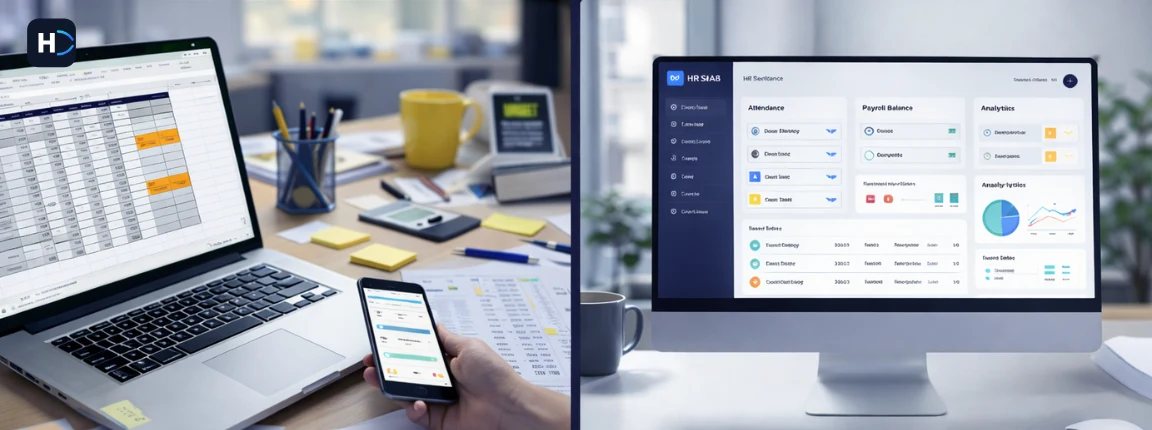

Attendance is in the biometric system. Leave balances are in a spreadsheet. Salary structures live in a shared drive that three people have edited this month. Statutory deductions are calculated by someone in finance who learned the rules two years ago and has not been formally updated since. And when the payroll run is due, all of this has to come together, accurately, on time, and in compliance with regulations that are not forgiving of errors.
This is not a small-company problem. It affects IT firms on OMR with 500 employees, BPO operations in Guindy running three shifts, and manufacturing units in Sriperumbudur managing contract and permanent workers simultaneously. The common thread is fragmentation, workforce data spread across systems that do not talk to each other, managed by teams that spend more time reconciling information than acting on it.
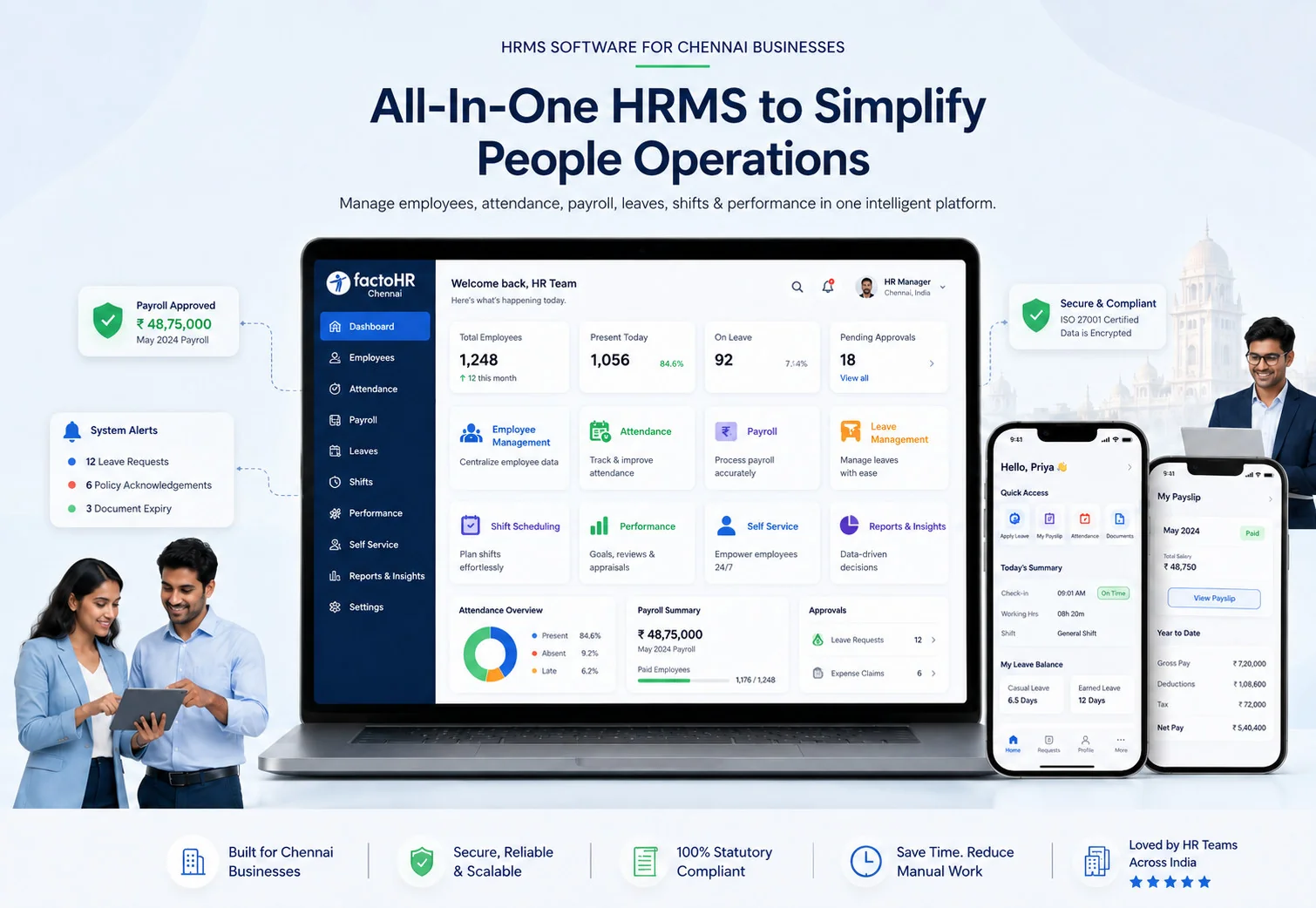
A unified workforce platform solves this at the root. Not by adding another tool to the stack, but by replacing the stack entirely with a single system where attendance, leave, payroll, compliance, and analytics all live together, update in real time, and eliminate the reconciliation work that consumes HR’s most productive hours.
This article explains what that visibility actually looks like in practice, and why it matters specifically for Chennai’s regulatory environment, workforce complexity, and industry mix.
In summary:
A unified workforce platform gives Chennai HR teams a single, real-time view of their entire workforce, attendance, leave, payroll status, compliance exposure, and analytics, without manual data consolidation. The result is faster decisions, fewer errors, and compliance that is built in rather than bolted on.
Why Fragmented HR Systems Cost Chennai Teams More Than They Realize
The cost of running disconnected HR tools is rarely visible on a single line of the budget. It is distributed across payroll correction time, compliance penalties, manager hours lost to administrative tasks, and employee frustration that slowly drives attrition. Individually, each cost seems manageable. Together, they represent a significant operational drag.
The four fragmentation costs that add up fastest:
- Payroll errors from stale data: When attendance and leave data are manually transferred to the payroll system, version mismatches are inevitable. A leave approval that came in after the export, an attendance correction that was not communicated in time, each one produces a payroll error that takes hours to investigate and correct, and erodes employee trust when it affects their salary.
- Compliance gaps from disconnected rules: Tamil Nadu’s statutory obligations, Shops Act working hour limits, Factories Act overtime rules, ESI threshold monitoring, PT slab application, must be applied consistently every month. When the rules live in someone’s memory or a reference document rather than in the system, they are applied inconsistently. Inconsistency is what inspectors find.
- Manager time lost to attendance administration: Line managers in Chennai’s IT and manufacturing sectors spend an estimated 4 to 6 hours per week on attendance-related tasks: approving corrections, chasing missing punches, answering leave balance queries, and manually updating rosters when staff changes.
- Employee frustration from opacity: An employee who cannot check their own leave balance without emailing HR, who receives a payslip without understanding how a deduction was calculated, or who discovers a salary error two weeks after payday is not a disengaged employee by choice. The system made them that way.
The fragmentation tax:
A conservative estimate for a 200-person Chennai organization running three disconnected HR systems puts the annual cost of fragmentation, payroll corrections, compliance penalties, manager administration time, and HR reconciliation hours, at Rs. 8 to 15 lakhs per year. A unified platform typically costs a fraction of that.
What Unified Visibility Actually Means
The word visibility is used loosely in HR technology marketing. In practice, unified visibility means seven specific things that fragmented systems cannot deliver.
1. Real-Time Attendance Across All Locations and Work Types
What fragmented systems deliver: Attendance data from the biometric terminal is available after the nightly sync. The remote team’s self-declared attendance is in a spreadsheet that someone updates when they remember. The hybrid employees’ in-office days are tracked informally by their managers.
What a unified platform delivers: Every clock-in, biometric, mobile, web, updates the central dashboard in real time. A manager in Chennai can see, at any moment, exactly who is on-site at the Sriperumbudur plant, who is working remotely from their Velachery apartment, and who has not clocked in for a shift that started 40 minutes ago. Exceptions surface automatically. Nothing waits for a nightly batch process.
Why this matters in Chennai: Organizations operating across multiple locations, an IT company with offices in Tidel Park and Perungudi, a manufacturer with plants in Ambattur and Oragadam, cannot manage attendance visibility without a system that consolidates all sources in real time. The alternative is a patchwork of location-specific reports that are always slightly out of date.
2. Leave Balances and Absence Patterns That Are Always Current
What fragmented systems deliver: Leave balances are accurate as of the last time someone updated the spreadsheet. Absence patterns are visible only to those who know to look, and only in retrospect.
What a unified platform delivers: Every leave application, approval, and rejection updates the employee’s balance instantly. HR and managers see current balances at all times, not end-of-month snapshots. The system also tracks absence patterns automatically, flagging employees whose unplanned absences follow a consistent pattern that often precedes resignation or performance issues.
Chennai context: With attrition rates of 25 to 40 percent in the city’s IT and BPO sectors, early identification of disengagement signals, of which irregular attendance is one of the most reliable, is a retention tool, not just an HR administrative function.
3. Payroll Inputs That Are Accurate Before Processing Begins
What fragmented systems deliver: Payroll inputs are assembled by manually pulling data from attendance, leave, and variable pay sources the day before the salary run. Errors discovered after payroll is processed require corrections in the next cycle, or worse, off-cycle payments that disrupt accounting.
What a unified platform delivers: Payroll inputs, attendance-based working days, approved leave and LOP, overtime hours, variable pay components, are calculated continuously throughout the month. When the payroll run begins, the inputs are already verified. HR is not assembling data under deadline pressure; they are reviewing a pre-calculated output and approving exceptions.
Time impact: Organizations that move from manual payroll input assembly to unified platform processing report a reduction in payroll preparation time from 2 to 3 days to under 3 hours for a 100-person team.
4. Statutory Compliance Status Visible at All Times
What fragmented systems deliver: Compliance status is known at the point of filing, and not always accurately. ESI threshold breaches, overtime limit violations, and PT slab misapplications are discovered during audits, not before them.
What a unified platform delivers: Compliance exposure is visible in real time. The system monitors every employee’s ESI eligibility continuously, alerts HR when a salary revision pushes someone above the Rs. 21,000 threshold, tracks cumulative overtime against Factories Act quarterly limits, and confirms that PT is being applied at the correct slab. When a filing deadline approaches, the statutory report is already prepared from live data, not assembled from memory.
Tamil Nadu regulatory context: The Shops and Establishments Act, the Factories Act, and the central Labour Codes each impose specific attendance, overtime, and leave obligations with penalties for non-compliance. A unified platform that applies these rules automatically, rather than relying on HR’s manual awareness of them, is the difference between compliance that is structural and compliance that is hopeful.
5. Manager Self-Service That Reduces HR’s Administrative Load
What fragmented systems deliver: Managers send attendance correction requests to HR by email. Leave approvals go through an email chain. Roster changes are communicated via WhatsApp. HR is the manual switchboard for all of it.
What a unified platform delivers: Managers handle their own team’s attendance corrections, leave approvals, and shift adjustments directly in the platform, with full audit trails. HR sets the rules and reviews exceptions; managers execute within those rules. The administrative load on HR drops by an estimated 60 to 70 percent for attendance-related tasks.
Why this matters: In Chennai’s mid-market organizations, HR teams are typically small relative to workforce size. A 5-person HR team managing 400 employees cannot afford to be the manual switchboard for attendance queries. Self-service tools are not a convenience, they are a structural requirement for HR to function at scale.
6. Employee Self-Service That Reduces Queries and Builds Trust
What fragmented systems deliver: Employees call or email HR to check leave balances, query payslip deductions, and report attendance discrepancies. Each interaction takes 10 to 15 minutes of HR time that adds no strategic value.
What a unified platform delivers: Employees access their own attendance records, leave balances, payslips, and shift schedules from a mobile app, in Tamil or English, without involving HR. Discrepancies can be flagged directly in the system and routed to the appropriate manager for resolution. Payslip queries drop by 60 to 70 percent within the first three months of deployment.
Retention impact: In a city where talent competition is intense, the administrative experience employees have with HR is an underappreciated driver of satisfaction.
7. Analytics That Enable Proactive Workforce Decisions
What fragmented systems deliver: Reports are produced at month-end, in formats that require manual interpretation, for decisions that needed to be made two weeks ago.
What a unified platform delivers: Live analytics on absenteeism rates by department, overtime cost trends by location, leave liability accumulation, and attrition risk signals based on attendance patterns. HR and business leaders see the same data, updated in real time, in dashboards that require no manual preparation.
Strategic value: Chennai’s largest employers in IT, manufacturing, and BPO are making workforce planning decisions that depend on accurate, current data. Organizations with unified platforms make these decisions from evidence. Those without them make them from estimates.
The 7 Visibility Checks a Unified Platform Automates
1. Multi-Source Attendance Consolidation
What goes wrong manually: Attendance data from biometric terminals, mobile apps, web portals, and manual submissions arrives in different formats at different times. HR consolidates it by hand, introducing errors at every step.
What the platform does: All attendance sources feed into a single dashboard automatically. Conflicts and missing data surface as exceptions that must be resolved before payroll proceeds. The system enforces data completeness, payroll cannot run on incomplete attendance.
Time saved: 4 to 6 hours per payroll cycle for a 100-person team.
2. Live Leave and LOP Tracking
What goes wrong manually: Leave balances in spreadsheets are always slightly out of date. LOP is calculated manually, often using the wrong balance. Disputes follow.
What the platform does: Every leave transaction updates the balance in real time. LOP is calculated automatically when balance is exhausted and flows directly to payroll without manual entry.
Time saved: 2 to 3 hours per payroll cycle. Eliminates the most common source of salary disputes.
3. Statutory Compliance Monitoring
What goes wrong manually: ESI thresholds, overtime limits, and PT slabs are applied inconsistently when they depend on human memory and manual checks.
What the platform does: Rules are configured once and applied automatically every month. Threshold breaches trigger alerts before they become violations. Statutory reports are generated from live data on demand.
Compliance risk eliminated: Real-time monitoring replaces after-the-fact discovery during audits.
4. Shift and Schedule Management
What goes wrong manually: Shift rosters are built in Excel, communicated by WhatsApp, and modified without a central record. The roster that was planned and the one that was worked diverge silently.
What the platform does: Rosters are built, published, and modified in the system. Shift swaps create automatic audit trails. The attendance engine always works from the current, approved schedule.
Outcome: No more end-of-month reconciliation between planned and worked shifts.
5. Overtime Visibility and Control
What goes wrong manually: Overtime is approved verbally, recorded from memory, and entered into payroll manually. Errors in both directions, underpayment and overpayment, are common and difficult to detect.
What the platform does: Overtime is calculated from actual clock-in and clock-out data against the scheduled shift. Approval workflows create a pre-authorized record. Cumulative overtime is tracked against statutory limits with automated alerts.
Compliance note: Tamil Nadu Factories Act quarterly overtime limits are monitored per employee, with alerts before thresholds are reached.
6. Payroll Input Verification
What goes wrong manually: Payroll inputs are assembled under deadline pressure from multiple sources. Errors introduced at this stage are the leading cause of salary corrections and employee disputes.
What the platform does: Inputs are calculated continuously throughout the month. By payroll run day, the figures are pre-verified. HR reviews exceptions rather than assembling data from scratch.
Time impact: Payroll preparation time reduces from 2 to 3 days to under 3 hours for a 100-person team.
7. Audit-Ready Statutory Reporting
What goes wrong manually: Statutory reports, muster rolls, overtime registers, wage registers, are compiled manually when needed. The process takes days. The output is often not in the prescribed format.
What the platform does: All statutory reports are generated from live data in the formats required by Tamil Nadu’s Factories Act and Shops and Establishments Act. Available instantly, on demand, at any time.
| Report | Applicable Law | Generated By Platform |
|---|---|---|
| Muster Roll (Form 25) | Tamil Nadu Factories Act | Yes – monthly, auto-generated |
| Overtime Register | Tamil Nadu Factories Act | Yes – real-time accumulation |
| Wage Register | Tamil Nadu Shops Act | Yes – linked to payroll data |
| Leave Register | Tamil Nadu Shops Act | Yes – updated with every transaction |
| Annual Return (Form 22) | Tamil Nadu Factories Act | Yes – compiled from year’s data |
| ESI Contribution Statement | ESI Act | Yes – monthly, per employee |
Industry-Specific Visibility Gains in Chennai
| Industry | Primary Visibility Gap | What the Platform Delivers |
|---|---|---|
| IT / Software (OMR, Tidel Park) | Hybrid attendance policy compliance | Location-tagged clock-in; in-office day tracking |
| BPO / ITES (Guindy, Ambattur) | Real-time shift adherence | Live shift dashboard; understaffing alerts |
| Manufacturing (Sriperumbudur, Oragadam) | Contract vs. permanent workforce separation | Parallel attendance rules in one system |
| Healthcare (Nungambakkam, Perambur) | Credential-linked scheduling | Certification status tied to shift eligibility |
| Retail / FMCG (city-wide) | Field workforce location verification | GPS-verified mobile clock-in with geofencing |
Conclusion
The visibility problem in Chennai HR is not a technology gap, it is an architecture gap. Most HR teams already have tools. What they do not have is a single system where those tools work together, update in real time, and eliminate the reconciliation work that consumes the majority of HR’s operational time.
A unified workforce platform closes that gap. Not gradually, and not partially, but completely, from the first payroll cycle after go-live. Attendance consolidates automatically. Leave and payroll stay in sync. Compliance rules apply themselves. Managers handle their own teams. Employees serve themselves. And HR finally has the time and data to function as a strategic partner rather than a data assembly operation.
For Chennai organizations managing the complexity of multi-site operations, Tamil Nadu’s regulatory environment, and a workforce that spans factory floors, open-plan offices, and kitchen tables simultaneously, unified visibility is not a feature. It is the foundation.
Takeaway:
The best HR technology investment a Chennai organization can make is not the most sophisticated individual tool, it is the platform that eliminates the space between tools. When attendance, leave, payroll, compliance, and analytics share a single data layer, every HR decision becomes faster, every compliance obligation becomes easier, and every payroll run becomes something HR approaches with confidence rather than anxiety.